
Free Job Search Tracker Google Sheets: Secrets Inside
Free job search tracker Google Sheets stuck holding 40 open applications in your head? This template logs every role, flags overdue follow-ups automatically, and reveals response-rate math most job seekers in the US, UK, and Australia never actually calculate.

17 min read
August 2026
- Why a free job search tracker Google Sheets template beats memory in 2026
- What’s inside this free job search tracker Google Sheets template
- Step 1 — Setup tab
- Step 2 — Applications tab
- Step 3 — Interview tracker
- Step 4 — Dashboard
- The 3 secrets this free job search tracker Google Sheets template runs on
- How to read your data
- Add email reminders yourself
- A 6-week example
- Job application tracker Google Sheets vs. paid apps
- Need more? The Pro version
- Common questions
- FAQ
Why a Free Job Search Tracker Google Sheets Template Beats Memory in 2026
The job search in 2025 broke something. The median time to a first offer climbed from 57 days in Q1 to 83 days by Q4 — and that’s for candidates who got offers at all. Meanwhile, 75% of applications vanish with zero response, and 61% of candidates report post-interview ghosting.
If you’re applying to more than ten companies at once, your brain can’t hold the state of every application. That’s the exact gap this template is built to close — not by making the market kinder, but by making sure you never walk into a recruiter call blind.
One Reddit user in r/jobs described it perfectly: applying to 40+ roles over six weeks, then getting a surprise recruiter call with no idea which job it was, what resume version they’d sent, or what they’d written in the cover letter. The call ended in under two minutes.
A free job search tracker Google Sheets template fixes this. It’s functionally the same category as a job application tracker Google Sheets setup — the two phrases describe the same tool — but most versions circulating online are a single tab with ten columns and zero automation. This applies whether you’re job hunting in the US, the UK, or Australia; the follow-up math doesn’t change by country.
You don’t need a $29/month SaaS tool to do it. This template does everything the paid apps do, with no account, no data lock-in, and no subscription to cancel. If you already use a [Internal Link: “free expense tracker Google Sheets template” -> expense-tracker-google-sheets], the workflow is identical — one spreadsheet, fully yours, no vendor deciding when you lose access.
A gap between paychecks also means your finances need the same discipline as your applications. Pairing this tracker with a [Internal Link: “free budget tracker Google Sheets template” -> budget-tracker-google-sheets] and, if you’re carrying any balances, a [Internal Link: “free debt payoff calculator Google Sheets template” -> debt-payoff-calculator-google-sheets] keeps the financial side under control while you focus on landing the next role. If cash flow visibility matters more than debt payoff right now, a [Internal Link: “cash flow forecast template” -> cash-flow-forecast-template] does the same job for irregular income during a search.
The 2025 reality check: At least 1 in 5 job postings in the US is fake or never intended to be filled, according to a 2025 Greenhouse Software study. Without this tracker, you have no way of knowing which roles deserve your energy and which are ghost jobs wasting it.
What’s Inside This Free Job Search Tracker Google Sheets Template
Most free job application tracker Google Sheets templates are a single tab with ten columns and no formulas. This free job search tracker Google Sheets template is built differently — five tabs that work together, with data flowing automatically between them so you never enter the same thing twice.
| Tab | What it does | Key feature |
|---|---|---|
| ⚙️ Setup | Configure your weekly goal, salary target, and all dropdown values | All dropdowns pull from here — change once, updates everywhere |
| 📋 Applications | Main log for every job you apply to or bookmark | Overdue rows turn amber automatically when Next Action Date passes |
| 🎯 Interviews | One row per interview round, linked to Applications | Tracks interviewer, format, thank-you sent, and outcome per round |
| 📊 Dashboard | Live overview of your entire search | Response rate, interview rate, offer rate, and overdue follow-up list |
| 📖 How to Use | Built-in step-by-step guide | Ghost job detection tips and follow-up timing reference |
Step 1 — Setup Tab in Your Free Job Search Tracker Google Sheets Template
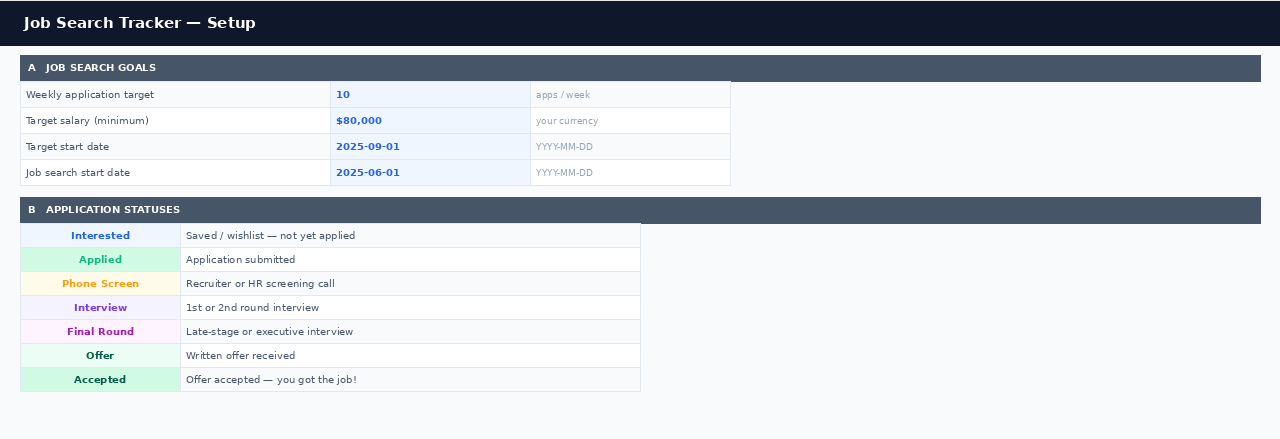
Open the free job search tracker Google Sheets template and go to the Setup tab first. This is where you define everything the rest of the job tracker Google Sheets file uses — weekly application target, minimum salary, and search start date in rows 5–8.
Five sections cover all the dropdown values: application statuses, job sources, work modes, next action types, and rejection reasons. Every value is editable — every dropdown in the Applications tab updates instantly.
Tip: Set a realistic weekly target in Setup row 5. Research consistently shows 10–15 targeted applications per week outperforms spraying 50 generic ones. Your Dashboard tracks whether you’re on pace every Monday.
Step 2 — Applications Tab in This Free Job Search Tracker Google Sheets Template
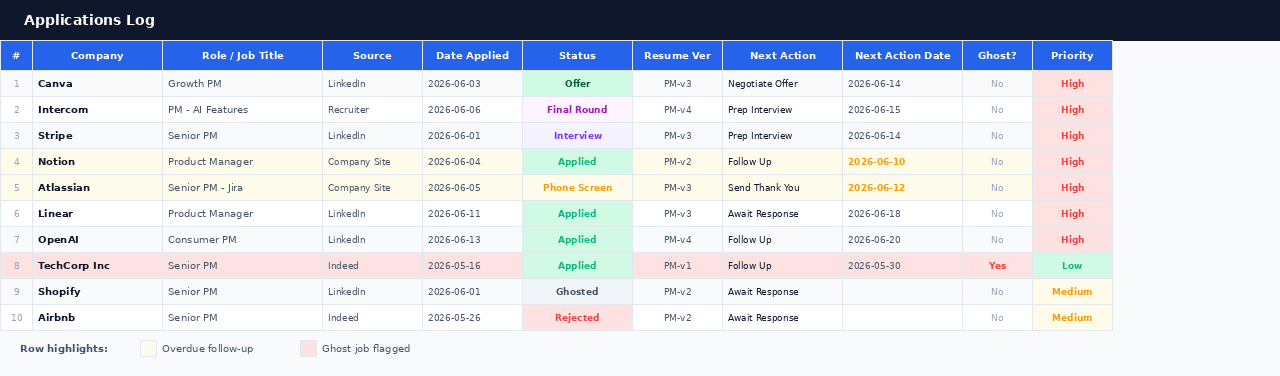
The Applications tab is the core of this free job search tracker Google Sheets template — and the part that makes it a genuine job application tracker Google Sheets system rather than a list. Every role you apply to, or even just bookmark as “Interested,” gets one row. Twenty columns, most filled by dropdown.
The columns that make the biggest difference in a long job search:
| Column | Why it matters |
|---|---|
| Job URL | Job postings disappear within days of closing. Save the URL immediately — you’ll need it when a recruiter calls three weeks later |
| Status | Colour-coded dropdown: Interested → Applied → Phone Screen → Interview → Final Round → Offer / Rejected / Ghosted / Withdrawn |
| Resume Version | Tracks which resume variation you sent. Over time this reveals which version drives more callbacks |
| Next Action | Follow Up, Prep for Interview, Send Thank You, Negotiate Offer — every open row must have one |
| Next Action Date | When the action is due. The entire row turns amber automatically when this date passes on an open application |
| Ghost Job? | Yes/No flag — cell turns red on Yes, telling you visually to stop chasing that role |
| Priority | High / Medium / Low, colour-coded. Helps you decide where to spend energy when the pipeline gets crowded |
The rule that keeps a free job search tracker Google Sheets template alive: every row must have a Next Action and a Next Action Date before you close the tab. No next action means a dead lead — give it a date, or mark it Withdrawn.
The status column is colour-coded automatically — no setup required. Applied in slate, Interview in blue, Offer in green, Rejected in red, Ghosted in amber. The state of your entire pipeline, and every job application spreadsheet row in it, is visible in three seconds.
Step 3 — Interview Tracker in This Free Job Search Tracker Google Sheets Template
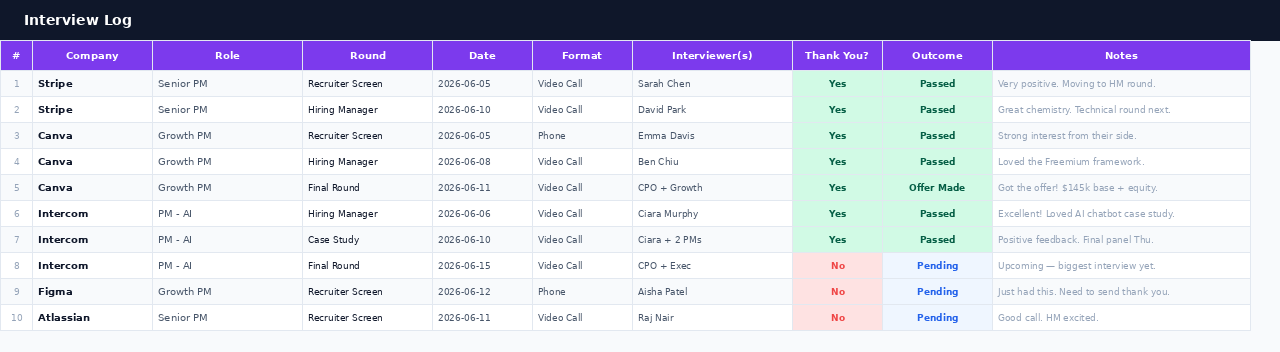
When you land an interview, log it in the Interviews tab — separately from the Applications tab. One row per round, not per company. Recruiter screen, hiring manager call, and final panel at the same company — that’s three rows.
The columns most people skip — and then regret:
Key Topics to Prep — the two or three things this specific interviewer will care about. Notes for a technical round look completely different from notes for a CPO panel.
Thank You Sent? — Yes/No/Pending, turns green on Yes and red on No. 61% of candidates report post-interview ghosting with no update, so a thank-you email is a small signal that you’re attentive.
Outcome — Passed, Rejected, No Feedback, Pending, Offer Made. Tracking this across every interview reveals which stages you’re strong at and which need work.
Step 4 — Dashboard in Your Free Job Search Tracker Google Sheets Template
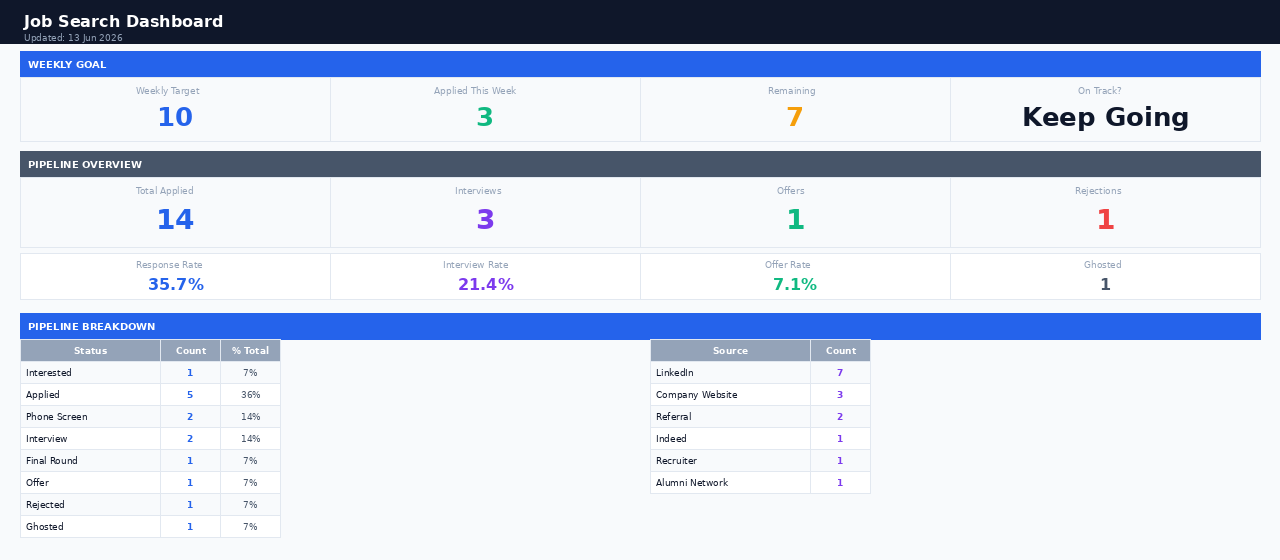
The Dashboard tab pulls everything together automatically. Open it each morning and it tells you three things instantly: are you on pace this week, where does your pipeline stand, and who needs a follow-up today.
Weekly Goal Widget — target vs applications submitted this week, updated daily. If it’s Thursday and you’ve sent 3 out of 10, you know what tonight looks like.
Pipeline Overview — total applied, interviews, offers, and rejections as KPI numbers, plus response rate, interview rate, and offer rate as percentages. Most job seekers genuinely don’t know their real response rate.
Pipeline Breakdown Table — application count by status and by source. This is where this tool earns its keep: if LinkedIn generates 60% of your applications but only 10% of your interviews, you know exactly where to redirect your energy.
Overdue Follow-Ups table — the section most job tracking spreadsheet setups skip entirely. It surfaces the ten most overdue applications automatically, sorted by days overdue, with no scrolling required.
Follow-up timing: The consensus from career coaches and Reddit’s r/jobsearchhacks is 5–7 business days after applying, and 24–48 hours after each interview round for a thank-you. Don’t let it drift past two weeks.
The 3 Secrets This Free Job Search Tracker Google Sheets Template Runs On
Every generic job application tracker Google Sheets file you can find online has a Company, Job Title, and Status column. That’s table stakes. What actually changes outcomes are three mechanics almost none of them include — and they’re the reason this free job search tracker Google Sheets template exists at all.
Secret 1 — the ghost job flag isn’t cosmetic, it’s a math correction. If 1 in 5 postings you apply to is fake, and you don’t flag them, your Dashboard’s response rate is quietly understating your real performance by roughly 20%. Flagging a ghost job removes it from the denominator, not just your mental list — that’s the difference between “12% response rate” feeling like failure and “15% response rate once you exclude dead postings” feeling like something you can actually work with.
Secret 2 — resume version tracking turns guesswork into a controlled test. Most job seekers send 2–3 resume variants without ever comparing results. Because every row in the Applications tab logs which version went out, after 15–20 applications you can filter by Resume Version and see, in hard numbers, whether “Resume_Marketing_v2” is outperforming “Resume_Marketing_v3” — the same logic as an A/B test, just applied to your job search instead of a landing page.
Secret 3 — the Next Action Date field is what actually prevents ghosting-by-omission. Most candidates don’t get ghosted by companies as often as they self-ghost their own follow-ups by forgetting a date existed. Because this field triggers the amber row highlight and feeds the Dashboard’s Overdue Follow-Ups table, a forgotten follow-up becomes structurally difficult, not just something you meant to remember.
Why this matters more than adding columns: A job tracker google sheets file with 40 columns and no ghost-job correction or resume attribution is still just a list. These three mechanics are what convert a list into a decision-making tool.
How to Read Your Free Job Search Tracker Google Sheets Data
Once you’ve used this free job search tracker Google Sheets template consistently for 3–4 weeks, the Dashboard stops being a simple counter and starts showing you patterns you couldn’t see before.
Response rate below 10% — this is a resume or targeting problem, not a volume problem. Sending more applications won’t move the number. Our [Internal Link: “free net worth tracker Google Sheets template” -> net-worth-tracker-google-sheets] uses the same pattern — tracking the right metric changes the behaviour, not just the awareness.
High response rate, low interview rate — your written materials are working, but something’s stalling at the phone screen. This almost always points to verbal positioning, so practice your “tell me about yourself” answer out loud, with a timer.
Good interview rate, no offers — you’re reaching late stages but not closing. This is typically a final-round preparation, negotiation, or culture-fit issue worth studying company by company.
LinkedIn dominates your source breakdown but has the worst conversion — extremely common. With 64.8% of organisations now using skills-based hiring, referrals and direct applications consistently outperform LinkedIn applications in conversion rate.
The data will be uncomfortable at first. A 5% response rate means 95 out of 100 applications go nowhere. That’s not a personal failing — only 3% of applicants get invited to interview on average, and this template doesn’t fix the market, it just helps you work it more deliberately.
Add Email Reminders Yourself to This Free Job Search Tracker Google Sheets Template
This free job search tracker Google Sheets template already turns overdue rows amber inside the sheet. If you’d rather get a nudge in your inbox instead of remembering to open the tab, Google Sheets lets you build that yourself in a few minutes with Apps Script — no coding experience required.
The concept is simple: a time-driven trigger runs once a day, scans the Applications tab for any row where the Next Action Date has passed and the status is still open, then emails you a short digest listing those companies. Google’s own Apps Script installable triggers documentation covers the exact setup steps for a daily time-based trigger.
Keep it simple: Start with one trigger and one condition — overdue Next Action Date. Once that’s working reliably in your tracker, you can expand it to flag ghost jobs or summarise your weekly response rate too.
This isn’t a built-in feature of the template — it’s a DIY layer you add on top using standard Google Sheets functionality. If Apps Script feels like more than you want to manage, the amber row highlighting and the Dashboard’s overdue table already do the same job without leaving the spreadsheet.
A 6-Week Example Using This Free Job Search Tracker Google Sheets Template
Here’s what a typical six-week stretch might look like using a free job search tracker Google Sheets template, illustrating how the tabs work together in practice rather than in isolation.
Week 1 — 12 applications logged in the Applications tab, each with a Job URL, Resume Version, and a Next Action Date one week out. Source is tagged for every row so the Dashboard breakdown means something later.
Week 2 — three recruiter screens booked, logged as separate rows in the Interviews tab. Two applications pass 7 days with no reply, so their Next Action shifts to “Follow Up” with a fresh date.
Week 3 — one role goes quiet for three weeks with a generic “competitive salary” listing and no named contact; it gets flagged Yes in the Ghost Job? column and drops out of the mental pipeline. One phone screen converts to a hiring-manager round.
Week 4 — the Dashboard shows an 18% response rate and a 25% interview rate from 24 total applications, right in the healthy range career coaches recommend. LinkedIn-sourced applications are converting at half the rate of referrals, so week 5’s target shifts toward warm introductions.
Week 5–6 — a final round leads to an offer. Because the Interviews tab logged every prep note and outcome by round, walking into the negotiation call means already knowing exactly which stage historically needed the most work.
Through all six weeks, the free job search tracker Google Sheets template stayed the single source of truth. For the parts of life a job search touches outside the applications themselves — bills, debt, and daily structure — a [Internal Link: “free personal finance OS Google Sheets template” -> personal-finance-os-google-sheets] and a [Internal Link: “Notion Life OS template” -> notion-life-os-template] cover the rest without adding another dozen apps to check. If the search also means chasing freelance income on the side, the same tracking logic applies to a [Internal Link: “freelance invoice tracker Google Sheets template” -> freelance-invoice-tracker-google-sheets].
Job Application Tracker Google Sheets vs. Paid Apps
For most job seekers, a free job search tracker Google Sheets template is the right call. It’s free forever, requires no account, and your data stays in your own Drive. Paid apps like Teal or Huntr add browser extensions and Kanban views, but lock those features behind $15–29/month subscriptions.
| Factor | Free job search tracker Google Sheets | Paid apps (Teal, Huntr) |
|---|---|---|
| Cost | Free forever | $15–29/month for full features |
| Data ownership | Yours, always | Locked to the platform |
| Customisation | Full — add any column or tab | Limited to what they build |
| Offline access | Yes (Google Sheets offline mode) | Varies by app |
| Learning curve | Minutes | Hours for full feature set |
Why a Job Application Spreadsheet Still Beats a Subscription in 2026
The honest trade-off: a job application spreadsheet requires you to enter data manually, while paid apps can sometimes auto-capture a posting via browser extension. If you’re applying to 100+ roles and hate manual entry, that convenience might be worth paying for. For everyone else, this template does the same job at zero cost — and a job application spreadsheet you own outright never disappears if the vendor shuts down or changes its pricing tier.
Need More? The Pro Version of This Free Job Search Tracker Google Sheets Template
This free job search tracker Google Sheets template covers everything most people need. But if you’re managing a competitive search across multiple industries — juggling offer negotiations, networking contacts, weekly goals, and interview prep simultaneously — the Pro version was built for exactly that.
It adds six tabs to the free foundation: a Contacts CRM for recruiters and hiring managers (the same spirit as our [Internal Link: “personal CRM Notion template” -> personal-crm-notion] and [Internal Link: “Notion Freelancer CRM template” -> notion-freelancer-crm-template], but scoped to your job search), a 12-week Weekly Planner, a weighted Offers Comparison matrix, an Interview Prep workspace, an Email Templates library, and an AI Report tab.
The applications log expands to 1,000 rows and a monthly Action Calendar shows every upcoming next action laid out by date, colour-coded by status.
The biggest differentiator is the built-in Gemini AI. Five tools run directly inside the spreadsheet using your free API key — paste a job description and get 10 tailored interview questions with STAR scaffolds, score your resume against any JD for ATS match percentage, extract structured fields from a raw posting in one click, and draft a contextual follow-up email based on your current status.
Free Job Search Tracker Google Sheets Template
Copy to your Google Drive in one click. No account, no email, no payment — free forever.
✓ Colour-coded status + automatic overdue alerts
✓ Live dashboard with response rate
✓ Ghost job flag column
✓ Works in Google Sheets and Excel
Job Search Tracker Pro — Google Sheets + AI
11 tabs, 1,000 application rows, 5 built-in Gemini AI tools, monthly action calendar, and weighted offer comparison. One-time purchase — no subscription.
✓ 1,000 application rows (5× the free version)
✓ Monthly Action Calendar — colour-coded by status
✓ 5 Gemini AI tools — interview prep, ATS scoring, email drafts
✓ Weighted offer comparison — up to 10 custom criteria
✓ Works in Google Sheets and Excel 2021+
| Feature | Free | Pro — $9.90 |
|---|---|---|
| Application rows | 200 | 1,000 |
| Tabs | 5 | 11 |
| Dashboard + overdue alerts | ✓ | ✓ |
| Colour-coded status + ghost job flag | ✓ | ✓ |
| Contacts CRM | — | ✓ |
| Weekly Planner (12-week rolling) | — | ✓ |
| Monthly Action Calendar | — | ✓ |
| Weighted Offer Comparison | — | ✓ |
| AI Interview Question Generator | — | ✓ |
| AI Resume vs JD Scorer (ATS %) | — | ✓ |
| AI Follow-Up Email Drafter | — | ✓ |
| AI Search Health Report | — | ✓ |
Common Questions About This Free Job Search Tracker Google Sheets Template
How many jobs should I apply to per week to land a role in 2026?
Most career coaches recommend 10–15 targeted applications per week logged in a free job search tracker Google Sheets template, balancing volume with quality. Sending 50+ generic applications without tailoring typically results in a response rate under 2%.
- 10–15 targeted apps/week — sustainable, allows proper tailoring, maintains response rate quality
- Healthy response rate — 15–25% is strong; below 10% signals a resume or targeting issue
- Follow-up timing — 5–7 business days after applying; 24–48 hours after each interview round
- Average time to offer in 2025 — 68.5 days on average, longer in Q4
What’s the difference between a ghost job and one I just haven’t heard back from?
A ghost job is a posting with no genuine open role behind it, while a slow response is simply a company that moves slowly. The Ghost Job? flag in this free job search tracker Google Sheets template exists so you stop chasing the first kind entirely.
- Ghost job signs: posting live 60+ days, no named contact, same role reposting repeatedly
- Slow company signs: recent LinkedIn activity, team posts, posting under 30 days old
- At least 1 in 5 US postings is fake or never filled — the flag helps you stop spending time on them
Should I use a Google Sheets job application tracker or a paid app like Teal or Huntr?
For most job seekers, a free job search tracker Google Sheets template is the right call — it’s free forever, requires no account, and your data stays in your own Drive. Paid apps add browser extensions and Kanban views, but lock those features behind $15–29/month subscriptions.
- Choose the spreadsheet if you’re applying to under 100 roles and want full data ownership
- Choose a paid app if you specifically need browser-extension autofill for high-volume applying
- A google sheets job application tracker costs $0 versus $15–29/month for the paid alternative
Frequently Asked Questions About This Free Job Search Tracker Google Sheets Template
Is this free job search tracker Google Sheets template really free?
Yes, this free job search tracker Google Sheets template is completely free. Copy it to your Google Drive in one click — no email address, no account, no payment, ever.
Does this free job search tracker Google Sheets template work in Microsoft Excel too?
Yes. All formulas, dropdowns, and conditional formatting in this free job search tracker Google Sheets template are compatible with both Google Sheets and Microsoft Excel 2016 and later.
How many applications can I track in the free version?
The free job search tracker Google Sheets template supports 200 application rows and 200 interview rows — enough for most job searches. If you need 1,000 rows and a Contacts CRM, the Pro version covers that for a one-time $9.90.
Can I add my own job sources or status values to this job application tracker Google Sheets template?
Yes. All dropdown values in this free job search tracker Google Sheets template live in the Setup tab — replace any existing value and the change updates every dropdown in the Applications tab immediately.
How does the overdue follow-up alert work?
The free job search tracker Google Sheets template has a Next Action Date column. When that date passes and the status is still open, the entire row turns amber automatically, and the Dashboard’s Overdue Follow-Ups table surfaces the ten most overdue applications.
What is the Ghost Job? column for?
Ghost jobs are postings with no genuine open role behind them. Mark a suspicious posting as Yes in this free job search tracker Google Sheets template and the cell turns red, telling you visually to redirect that follow-up energy elsewhere.
Can I use this as a simple job tracker Google Sheets file without touching the Pro tabs?
Yes. This job tracker Google Sheets file works fully on the free 5-tab version alone — the Applications, Interviews, and Dashboard tabs cover the core workflow, and the Pro tabs are purely additive for larger, more complex searches.
Is there a Pro version of this free job search tracker Google Sheets template?
Yes — Job Search Tracker Pro is available now at $9.90 one-time. It adds 11 tabs, 1,000 application rows, a Contacts CRM, a 12-week Weekly Planner, a Monthly Action Calendar, a Weighted Offer Comparison matrix, and 5 built-in Gemini AI tools.
Building free tools so you don’t have to pay for software you’ll use twice. Every template on this site is designed to work without an account, a subscription, or your data leaving your own Drive.