
Cash Flow Statement Example (Free Template, 2026)
This cash flow statement example uses real transactions from a small service business, built both the direct and indirect way, so you can see exactly how operating, investing, and financing activities connect (with a note on where US GAAP and UK/IFRS presentation actually differ).

This post walks through one full cash flow statement example for a small design studio, prepared both the direct and indirect way, with the same ending numbers so you can see exactly how the two methods connect. It also covers reading the example for warning signs, and where GAAP and IFRS presentation genuinely differ.
- What a Cash Flow Statement Example Actually Shows
- Cash Flow Statement Example: Direct Method
- Cash Flow Statement Example: Indirect Method
- Reconciling Direct and Indirect: Same Number, Different Paths
- Cash Flow Analysis Example: Reading It Like a Lender Would
- GAAP vs IFRS: Where the Example Actually Changes
- Build Your Own Cash Flow Sheet Example in Under 15 Minutes
- 5 Mistakes That Wreck a Cash Flow Statement Example
- Cash Flow Statement Example vs. Cash Flow Forecast
- People Also Ask
- FAQ
What a Cash Flow Statement Example Actually Shows
Most cash flow statement example pages online use a generic “TechCo” with round, disconnected numbers. That’s fine for a textbook. It’s less useful when you’re trying to check your own numbers against something real.
So this one uses an actual small business: Riverside Design Co., a five-person freelance design studio. Every number below ties back to the same underlying transactions, whether you’re looking at the direct or the indirect version.
A cash flow statement has three sections, always in the same order: operating activities, investing activities, and financing activities. Each section answers a different question about where the cash actually went.
Also Called a Cash Statement Example
You’ll sometimes see this same document called a cash statement example, a cash flow sheet example, or a statement of cash flows example, depending on the textbook or the accounting software menu. It’s the identical three-section document either way, just a different shorthand for it.
Riverside’s numbers below aren’t rounded for convenience. They’re built so the direct method total and the indirect method total land on the exact same figure, which is the part most cash flow statement example templates skip.
Cash Flow Statement Example: Direct Method
The direct method lists actual cash receipts and cash payments. No adjustments, no starting from net income. Just money in, money out, sorted into categories.
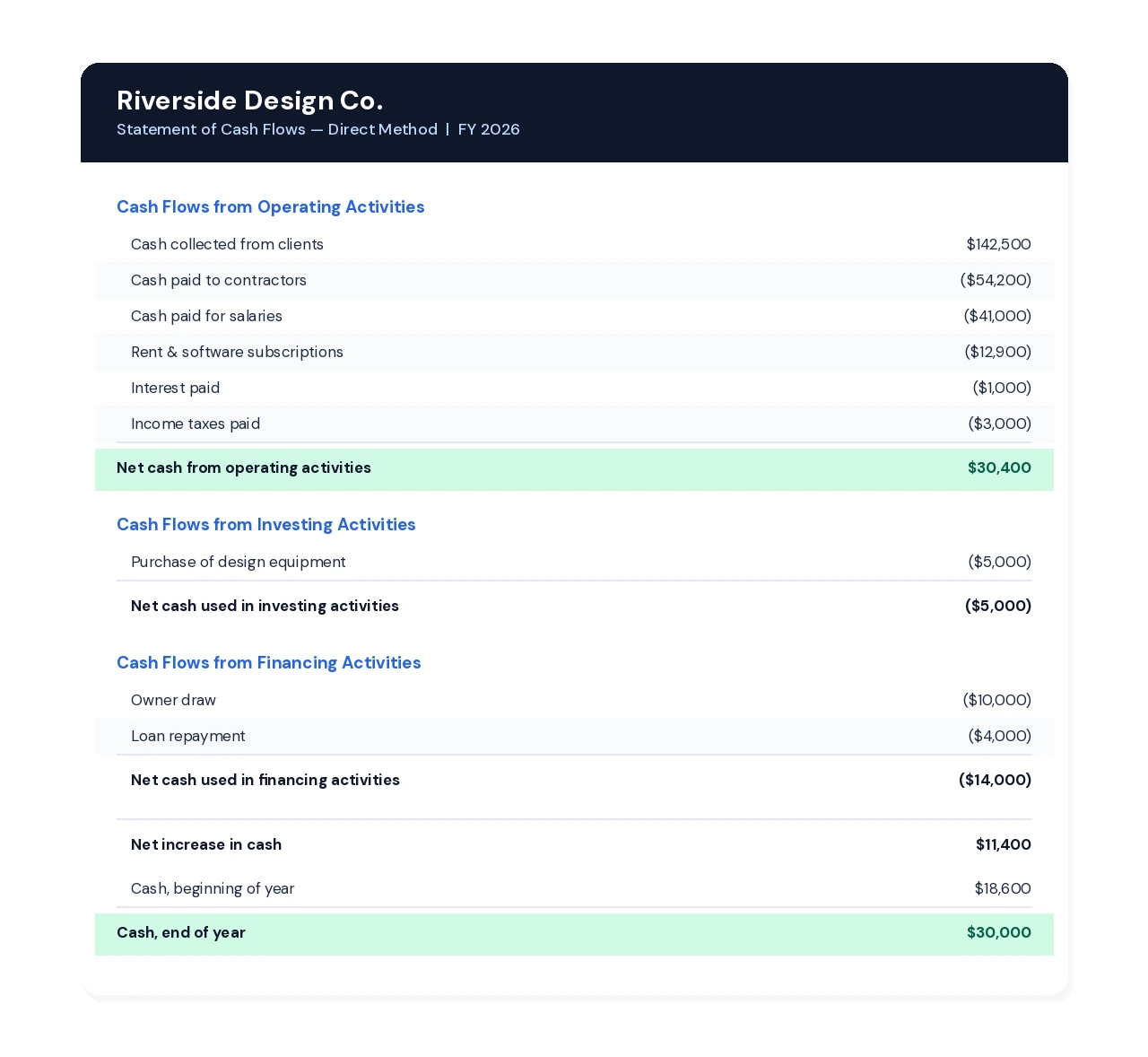
Notice the operating section lists exactly what happened: $142,500 collected from clients, $54,200 paid to contractors, $41,000 in salaries, $12,900 for rent and software, $1,000 in interest, $3,000 in taxes. Net cash from operating activities: $30,400.
Below that, investing activities show a $5,000 equipment purchase, a real cash outflow, distinct from a depreciation expense. Financing activities show a $10,000 owner draw and a $4,000 loan repayment, for $14,000 out.
Net change in cash: $11,400. Ending cash: $30,000.
Cash Flow Statement Example: Indirect Method
The indirect method starts somewhere completely different: net income from the income statement. Then it adjusts for non-cash items and changes in working capital until it arrives at the same operating cash figure.
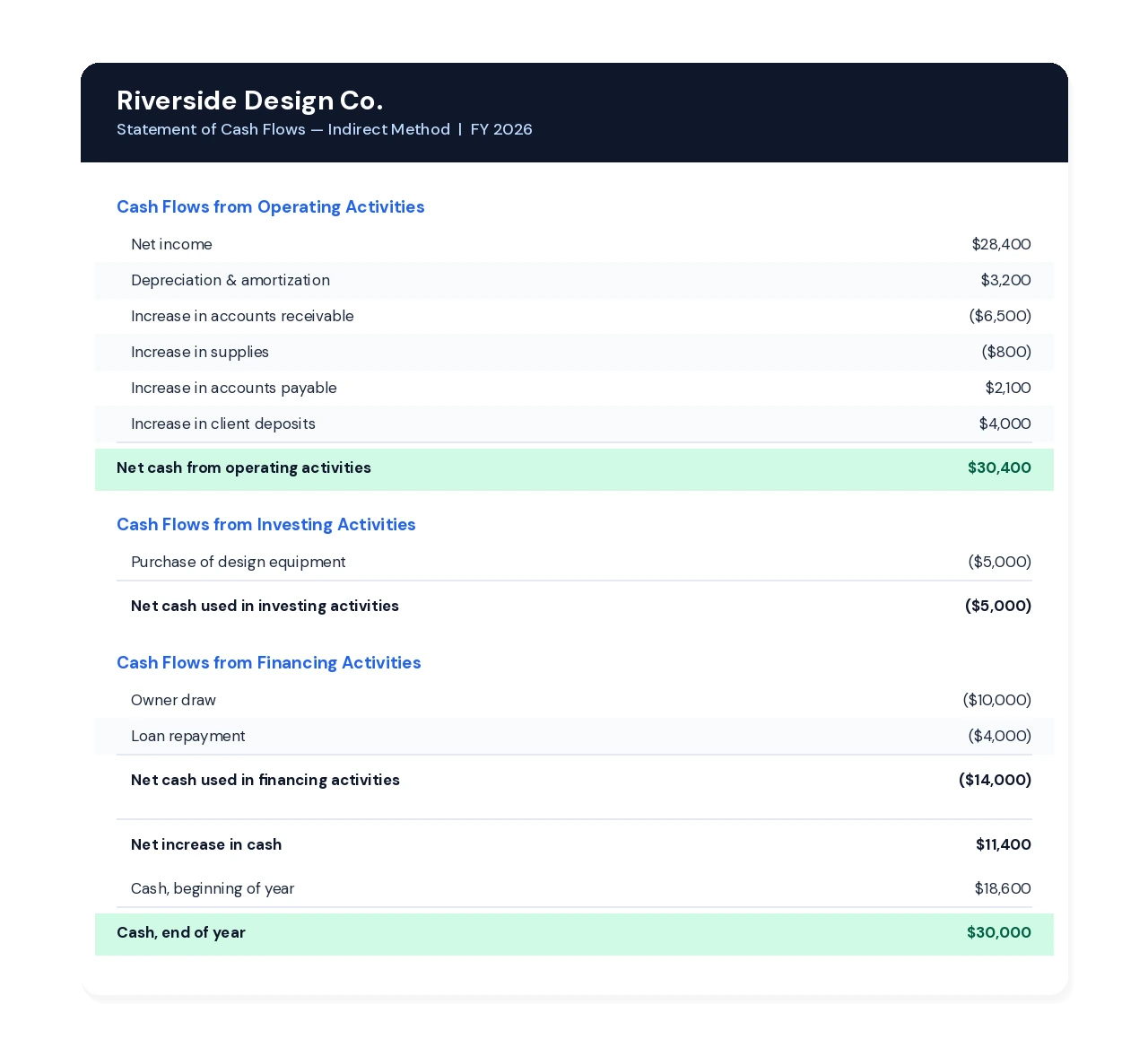
Riverside’s net income was $28,400. Depreciation gets added back at $3,200, since it reduced profit but never touched the bank account. Then working capital shifts: accounts receivable grew by $6,500 (client invoices not yet paid), which subtracts cash even though it counted as revenue.
Supplies grew by $800 (subtract). Accounts payable grew by $2,100 and client deposits grew by $4,000 (both add cash, since the business is holding money or owing less than it appears to on paper). Add it up: $28,400 + $3,200 − $6,500 − $800 + $2,100 + $4,000 = $30,400.
Same number as the direct method. That’s not a coincidence. It’s the entire point of the indirect method existing at all.
Reconciling Direct and Indirect: Same Number, Different Paths
Most cash flow statement example resources show these two methods as if they’re unrelated, each with its own made-up numbers. Here’s the same business, side by side, so the connection is obvious instead of assumed.
| What You’re Looking At | Direct Method | Indirect Method |
|---|---|---|
| Starting point | Actual cash receipts and payments | Net income from the P&L |
| Data source needed | A cash-basis ledger of every transaction | Income statement + two balance sheets |
| Effort to prepare by hand | High (most software doesn’t track it this way) | Low (built from existing reports) |
| Preferred by standard-setters | Yes, but rarely used in practice | No, but it’s what almost everyone files |
| Net cash from operations | $30,400 | $30,400 |
| Investing & financing sections | Identical either way | Identical either way |
That last row matters more than it looks. The direct-versus-indirect choice only changes how the operating section is presented. Investing and financing activities are reported the same way regardless of which method you pick for operations.
Cash Flow Analysis Example: Reading It Like a Lender Would
A lender reading this cash flow statement example isn’t checking your arithmetic. They’re checking whether the business generates cash on its own, separate from loans or owner contributions propping it up.
One specific ratio worth tracking: operating cash flow divided by net income. Riverside’s is $30,400 ÷ $28,400 = 1.07, meaning the business converted slightly more than 100% of its reported profit into actual cash. Above 1.0 is generally a healthy sign for a service business with modest receivables.
Watch for the opposite pattern: a company reporting solid net income but a ratio consistently under roughly 0.7 to 0.8, quarter after quarter. That usually means revenue is being recognized faster than clients are actually paying, and receivables are quietly piling up on the balance sheet.
A second check: does financing activity make up most of the increase in cash? In this cash flow statement example, financing activities are negative ($14,000 out), meaning the cash increase came entirely from operations, not new debt or an owner injection. That’s the pattern a lender wants to see.
GAAP vs IFRS: Where the Example Actually Changes
Most cash flow statement example content treats this as a US-only document, but the classification rules genuinely differ once you’re looking at a UK or international company.
Under US GAAP (via ASC 230), interest paid, interest received, and dividends received all sit in operating activities, while dividends paid always go under financing. IFRS is more flexible: a company can classify interest and dividends (paid or received) as operating, investing, or financing, as long as it’s consistent from year to year.
In Riverside’s example, the $1,000 in interest paid sits under operating activities, which is the required GAAP treatment. An equivalent UK business reporting under IFRS could legitimately move that same $1,000 into financing activities instead, and the statement would still be correct.
This is a small detail until you’re comparing two companies’ cash flow statement examples across borders and the operating cash flow numbers don’t line up for reasons that have nothing to do with performance.
Build Your Own Cash Flow Sheet Example in Under 15 Minutes
Building your own cash flow statement example from scratch in a blank spreadsheet means writing SUMIF formulas across three sections and hoping the direct and indirect totals actually match, which they often don’t on the first try.
The free cash flow statement template handles both methods automatically from the same transaction log, so the direct and indirect totals reconcile without any manual formula work. The free version includes a working operating-activities tab. The Pro version adds bank import, an annual summary, and a print-ready statement layout across 11 tabs.
If your business needs to track invoices before they turn into the receivables line on this statement, the freelance invoice tracker keeps a running Days Overdue count so a growing accounts-receivable balance doesn’t sneak up on you the way it did in the analysis section above.
And if client deposits are a regular part of your cash flow (the way they were in Riverside’s example), the Notion Freelancer CRM template tracks those against outstanding invoices automatically, so the deposit line in your own statement isn’t a guess.
5 Mistakes That Wreck a Cash Flow Statement Example
These aren’t typos. They’re the specific errors that make an otherwise correct-looking cash flow statement example produce a number that doesn’t tie back to the bank account. Every one of these has shown up in a real cash flow statement example someone sent in for a second look.
Mistake 1: Recording a loan repayment as an operating expense. The $4,000 loan repayment in this example belongs entirely in financing activities.
Only the interest portion of a loan payment is operating. The principal repayment is financing, every time.
Mistake 2: Treating capitalized equipment as an expense. Riverside’s $5,000 equipment purchase sits in investing activities, not operating. If you expense it in your books instead of capitalizing it, your cash flow statement example will show operating cash flow understated by exactly that amount.
The expense tracker template separates one-time capital purchases from recurring operating costs for this reason.
Mistake 3: Confusing a budget with an actual cash flow statement. A cash flow statement reports what already happened. A budget reports what you planned.
Mixing the two, pulling “budgeted” numbers into a statement that’s supposed to show actuals, is one of the fastest ways to produce a number a lender won’t trust. The budget tracker template keeps planned and actual figures on separate tabs specifically to avoid this.
Mistake 4: Ignoring the owner draw. A $10,000 owner draw is a real cash outflow under financing activities, even though it never touches the income statement. Sole proprietors and freelancers skip this line constantly, since there’s no “owner draw” account in most bookkeeping software by default.
Mistake 5: Mixing up net worth and cash flow. A cash flow statement tracks movement over a period. It has nothing to do with what the business is worth at a single point in time, since that’s a balance sheet’s job.
If you’re also tracking personal or business net worth, the net worth tracker template is a separate document for a separate question, and the two shouldn’t be merged onto one tab.
Cash Flow Statement Example vs. Cash Flow Forecast
A cash flow statement example, like the one above, always looks backward. It reports transactions that already happened, for a period that’s already closed.
A cash flow forecast looks forward instead. It projects what’s likely to happen over the next several weeks based on invoices due, recurring bills, and confidence-weighted assumptions about which clients will actually pay on time.
If you need to know whether you can make payroll six weeks from now, a historical statement won’t help. You need the Cash Flow Forecast Tracker, which runs a rolling 13-week projection instead of a closed-period report.
People Also Ask
What is an example of a cash flow statement?
A cash flow statement example reports cash movement across three sections: operating, investing, and financing activities, ending in the actual change in a company’s cash balance for the period. Riverside Design Co.’s version above shows $30,400 from operations, minus $5,000 in investing and $14,000 in financing, for a net increase of $11,400.
How do you calculate cash flow from an example?
Add net cash from operating, investing, and financing activities together to get the total change in cash for the period. Using the indirect method, operating cash flow itself is calculated by starting with net income and adjusting for non-cash items and working capital changes, as shown in the walkthrough above.
What is the easiest way to read a cash flow statement example?
Start at the bottom line of the operating section, not the top of the page. That single number tells you whether the core business generates cash on its own. Then check whether financing activities are propping up an otherwise negative operating result, since that’s the pattern that most often signals trouble.
Frequently Asked Questions
Is a cash flow statement the same as a cash flow forecast?
No. A cash flow statement reports what already happened during a closed period, while a forecast projects what’s likely to happen in the weeks ahead. They answer different questions and shouldn’t be built on the same tab.
Do I need a cash flow statement if I already have a profit and loss report?
Yes, because a P&L and a cash flow statement can tell completely different stories for the same period. A business can show solid net income on its P&L while its cash flow statement reveals that most of that “profit” is sitting unpaid in accounts receivable.
Which method should a small business use, direct or indirect?
Almost every small business uses the indirect method, since it can be built directly from existing bookkeeping software without re-tracing individual cash transactions. The direct method is more transparent to read but requires cash-basis records most accounting tools don’t keep by default.
Why do standard-setters prefer the direct method if almost nobody uses it?
The direct method shows actual cash receipts and payments, which is more useful to a reader than a reconciliation from net income. It’s rarely used anyway because most companies don’t organize their accounting records by cash movement, making it far more time-consuming to prepare.
What’s a healthy cash flow statement example for a small business?
A healthy example shows positive net cash from operating activities that roughly matches or exceeds reported net income, with financing activities playing a minor role rather than propping up the cash balance. Riverside’s 1.07 ratio of operating cash flow to net income in the analysis section above is a reasonable benchmark for a small service business.
Does IFRS handle interest and dividends differently from GAAP?
Yes. US GAAP requires interest paid, interest received, and dividends received in operating activities, with dividends paid always under financing. IFRS allows a company to classify any of these as operating, investing, or financing, as long as the choice stays consistent year to year.
Can a company be profitable and still run out of cash?
Yes, and it happens more often to fast-growing small businesses than to large ones. Rising accounts receivable can make a company look profitable on paper while operating cash flow turns negative, because the “profit” hasn’t actually been collected yet.
How often should a small business prepare a cash flow statement?
Monthly is standard for a business actively managing cash, though quarterly is common for businesses with steady, predictable income. Any month with a large one-time purchase or a new loan is worth checking regardless of your usual schedule.
What’s the real difference between cash flow and net income?
Net income is an accounting figure that includes non-cash items like depreciation and recognizes revenue when it’s earned, not when it’s collected. Cash flow tracks only the money that actually moved, which is why the two numbers rarely match exactly, as shown in Riverside’s $28,400 net income versus $30,400 operating cash flow.
Where do owner draws show up on a cash flow statement?
An owner draw is a financing activity, listed as a cash outflow, even though it never appears on the income statement. It’s one of the most commonly missed lines in a sole proprietor’s or freelancer’s cash flow statement example.
Skip the Manual Reconciliation: Get the Cash Flow Statement Template
The spreadsheet behind every number in this cash flow statement example is available as a free download, or as a Pro version with bank import, an annual summary, and a print-ready statement across 11 tabs.
✓ Bank import with AI categorization
✓ Annual summary and print-ready statement
| Tab | Free | Pro |
|---|---|---|
| Transaction log & statement (direct + indirect) | ✓ | ✓ |
| Bank import + AI categorization | — | ✓ |
| Annual summary | — | ✓ |
| Print-ready statement layout | — | ✓ |
Just Want the Free Version?
The free cash flow statement template covers the same direct and indirect method example shown above, ready to copy and fill in with your own numbers.
Building free and Pro spreadsheet templates for freelancers and small business owners who want their numbers straight without learning accounting software. Questions? Get in touch.