
Cash Flow Management for Small Business: Stop 5 Mistakes
Cash flow management for small business fails in five predictable ways, and each fix fits in a spreadsheet column or a formula. This guide shows the exact formulas, the edge cases and what 20,000 simulated schedules did when I changed one habit at a time.

18 min read
What’s in this post:
- Why a $3,000 profit month still cost $6,000 in cash
- A two-column fix that flagged 86.6% of real cash dip weeks, up from 46.1%
- What paying vendor bills on the due date did to the share of schedules that dipped
- A minimum cash floor that adds up your next four weeks of payroll, rent and recurring bills
- A weekly cash flow management for small business check with three steps and one decision, plus the formulas to run it
In this guide
- What is cash flow management for small business?
- Mistake 1: Treating profit as cash
- Mistake 2: Dating receipts by invoice terms
- Mistake 3: Paying every bill the day it arrives
- Mistake 4: Running without a minimum cash floor
- Mistake 5: Checking once a month
- The weekly routine: 3 steps and 1 decision
- Spreadsheet or software
- People also ask
Cash flow management for small business fails in five predictable ways. Each one is a timing mistake, and a spreadsheet can catch it weeks before the account runs short.
I’m Alex, and I sell a spreadsheet cash flow tracker, so weigh my opinions with that in mind. The simulations here use invented schedules and assumptions that I list in each section. They test a habit, and they aren’t field data about your business.
Every cash flow management for small business mistake below comes with what it costs, a fix with exact formulas and values, and an edge case where the fix needs adjusting. This guide is education and isn’t financial or tax advice, so check tax timing with an accountant.
What Is Cash Flow Management for Small Business? The Short Answer
Cash flow management for small business is the weekly habit of dating every expected receipt and payment, comparing the running balance with a minimum cash floor, and acting before a dip arrives. Stripe’s small business guide, citing the U.S. Chamber of Commerce’s small business index, reports only 24% of owners felt very comfortable with cash flow in Q4 2025.
Cash flow management for small business is a decision loop. A forecast predicts your balance, and management decides what you do this week when the forecast shows a dip. The cash flow forecasting guide covers building the 13-week forecast, and this guide covers the habits that keep it honest.
Stripe’s cash flow guide for small businesses makes the same point in plain terms. A business can show a profit on paper and still run short on cash when payments don’t line up.
Cash Flow Management for Small Business vs Budgeting and Forecasting
| Practice | Question it answers | What it looks at |
|---|---|---|
| Budgeting | How much can I spend in each category? | A month or a year, by category |
| Cash flow forecasting | What will my balance be in 13 weeks? | Weekly balances from dated receipts and payments |
| Cash flow management | What do I do this week about the lowest week? | Decisions, dates and a minimum balance |
A budget caps spending, and cash flow management checks whether the account survives the order that money moves in. You can run both from one set of numbers, and a budget tracker in Google Sheets handles the first job.
Small Business Cash Flow Management and the Five Cash Flow Problems Below
Cash flow problems in a small business usually look like a shortage at the worst moment. Payroll leaves on the 15th, the invoice you counted on lands on the 26th, and a profitable month ends with an empty account.
Stripe’s guide lists late customer payments, high overhead, thin cash reserves, poor forecasting, seasonal swings, inventory bottlenecks and fast growth without cash planning as the biggest culprits. The five mistakes below are the ones I can test in a spreadsheet, so each section turns a cash flow management strategy into a fix and a result.
Cash Flow Management for Small Business Mistake 1: Treating Profit as Cash
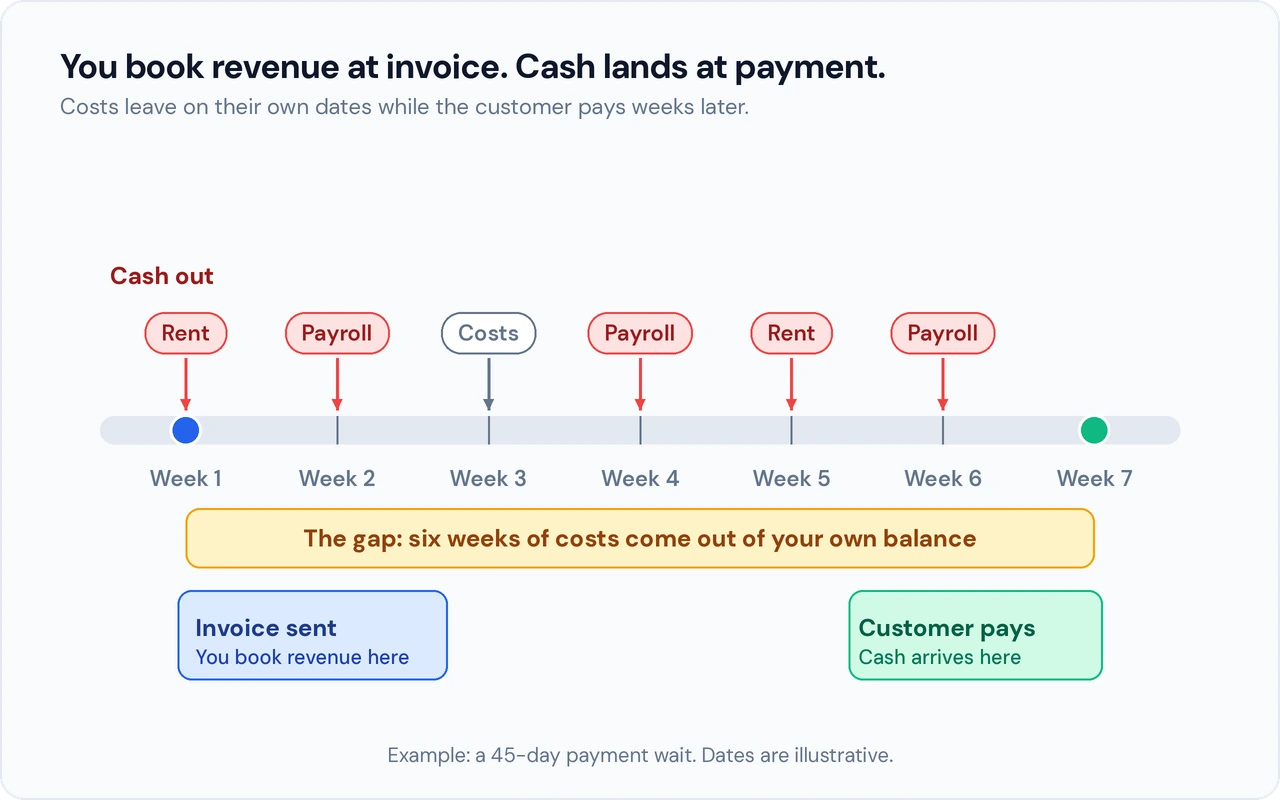
A profit report counts revenue when you invoice, and the bank counts cash when the customer pays. That gap is the whole story of cash flow vs profit, and it’s why a profitable month can still end in an overdraft.
Cash Flow vs Profit: One Invoice, Seven Weeks
Take a business with $12,000 in the bank, $1,500 of costs every week and one $9,000 invoice sent in week 1. The customer pays 45 days later, which lands in week 7. I invented every number in this example.
| Week | Cash in | Cash out | Closing balance | What happens |
|---|---|---|---|---|
| 1 | $0 | $1,500 | $10,500 | You send the $9,000 invoice |
| 2 | $0 | $1,500 | $9,000 | |
| 3 | $0 | $1,500 | $7,500 | |
| 4 | $0 | $1,500 | $6,000 | Month 1 closes with $3,000 of profit |
| 5 | $0 | $1,500 | $4,500 | |
| 6 | $0 | $1,500 | $3,000 | Lowest closing balance |
| 7 | $9,000 | $1,500 | $10,500 | The customer pays |
Month 1 shows $3,000 of profit on the income statement, which is $9,000 of revenue minus $6,000 of costs. The bank balance fell $6,000 over the same four weeks and kept falling to $3,000 before the customer paid. That cash flow vs profit gap is the first mistake in small business cash flow management.
Read only the profit line and you would hire this month. The cash line says wait until week 7. Keep the profit report for taxes and pricing, because in cash flow management for small business the weekly cash tab drives every spending decision.
Set up the cash tab with week start in A, opening balance in B, cash in in C, cash out in D, fixed outflows in E, closing balance in F, a floor in G and a flag in H. Closing balance is =B6+C6-D6, and you check any purchase larger than one week of costs against the lowest week in the next 13 before you make it. Each week’s opening balance equals the previous week’s closing balance.
Where Profit and Cash Disagree in Cash Flow Management for Small Business
- Cash-basis books show revenue when the customer pays you, so profit lines up better with receipts. Payroll and rent still leave first, so the gap before payment stays invisible.
- Loan principal leaves the account and doesn’t appear as an expense on a profit report. A debt payoff calculator for Google Sheets lays out each month’s payment so you can drop it into the cash tab.
- Equipment purchases hit cash on the purchase day and reach the profit report slowly through depreciation.
A cash flow statement example reports the past in three sections, so it can’t warn you about next month. A cash flow statement template reports history as well, and the weekly cash tab covers the weeks ahead.
Cash Flow Management for Small Business Mistake 2: Dating Receipts by Invoice Terms
Net 30 is a request. Every customer has a payment habit, and a forecast built on terms puts the cash in the wrong week. Nothing looks broken until the lowest week arrives early.
I tested cash flow management for small business receipts on 20,000 random six-month schedules. Both forecasts know every cost exactly, and the only difference is how they date customer receipts.
How I ran the cash flow management for small business simulations. Each schedule runs 26 weeks with an opening balance of $12,000 to $22,000, payroll of $1,400 every second week, $1,200 rent every fourth week, $300 of recurring bills each week and 2 to 3 lumpy bills of $600 to $2,000, while income is 12 to 16 invoices of $2,500 to $7,000 on net 30 terms across six customers. 40% of customers pay 0 to 3 days late, 40% pay 7 to 20 days late and 20% pay 20 to 45 days late with 3 days of noise on each invoice, you pay vendor bills of $400 to $1,800 on net 30 terms on their due dates, and the floor is $5,200 (seed 2612).
| Forecast dates receipts by | Real below-floor weeks flagged within one week | Lowest week matched within one week |
|---|---|---|
| Invoice terms (net 30) | 46.1% | 51.6% |
| Each customer’s payment history | 86.6% | 81.1% |
37.7% of schedules dipped below the $5,200 floor at least once. The terms forecast flagged 46.1% of the weeks that really dipped, and the history forecast flagged 86.6%. History also placed the lowest week within a week of the real one in 81.1% of schedules, against 51.6% for terms.
The history forecast raised 0.04 false-alarm weeks per schedule, and the terms forecast raised none. I’ll take that trade to catch the extra dips.
Two Columns That Fix Cash Flow Management for Small Business Receipts
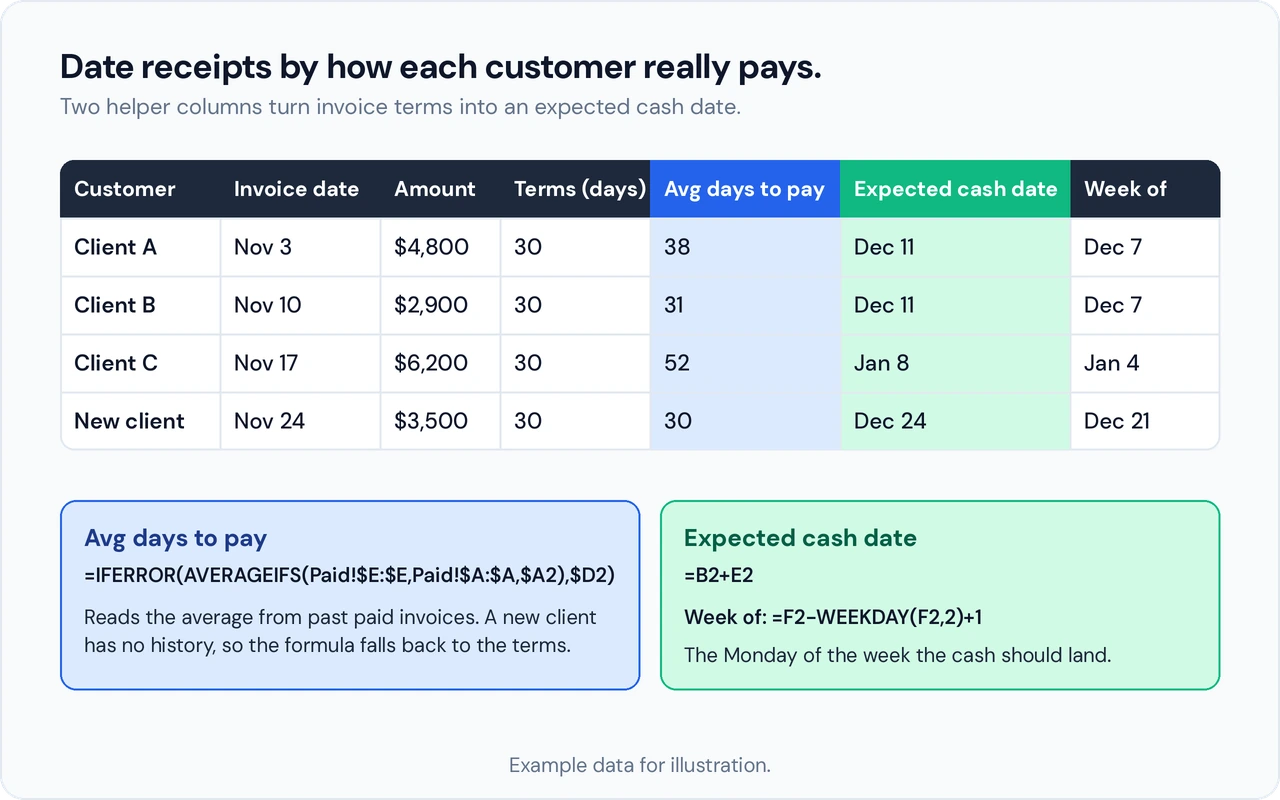
- Log every paid invoice on a Paid tab with the customer in A, the paid date in B, the invoice date in C, the amount in D and days to pay in E, using
=B2-C2. - Average the last 12 months per customer in the ledger’s column E with
=IFERROR(AVERAGEIFS(Paid!$E:$E,Paid!$A:$A,$A2,Paid!$B:$B,">="&EDATE(Settings!$B$1,-12)),$D2). The IFERROR falls back to the terms in D when a customer has no history. - Set the expected cash date in F with
=B2+E2, then find the Monday of that week in G with=F2-WEEKDAY(F2,2)+1. - Pull cash in by week on the cash tab with
=SUMIFS(Ledger!$C:$C,Ledger!$G:$G,$A6).
I keep =TODAY() in one cell, Settings!B1, instead of one per row, because a thousand volatile calls recalculate on every edit. I also use full-column ranges like Paid!$E:$E, since bounded ranges break when you add rows below them.
Edge Cases for Receipt Dates in Cash Flow Management for Small Business
- New customers have no history, so the formula uses their terms. I add 10 days by hand to a first invoice, and that 10 is my default rather than a standard.
- One very late payment drags an average. In Google Sheets or Excel 365, swap AVERAGEIFS for
=IFERROR(MEDIAN(FILTER(Paid!$E:$E,Paid!$A:$A=$A2)),$D2)to ignore the outlier. - One dominant customer deserves its own row. When a single client owns most of a month’s receipts, set its date by hand after a phone call.
A freelance invoice tracker already logs invoice and paid dates, which are the raw material for days to pay. If you keep clients in Notion, the Notion freelancer CRM template tracks clients and payments there, and the cash flow forecast template shows a full 13-week quarter with worked numbers.
Cash Flow Management for Small Business Mistake 3: Paying Every Bill the Day It Arrives
Vendor invoices on net 30 terms give you 30 days of someone else’s money. Paying each one the day it lands hands that money back early and pulls the dip forward.
I ran the same 20,000 schedules twice with identical customer payment dates. One run paid every vendor bill the day it arrived, and the other paid each bill on its due date.
| Vendor bill policy | Schedules that dipped below $5,200 | Average weeks below the floor | Median deepest shortfall |
|---|---|---|---|
| Pay the day it arrives | 48.7% | 2.08 | $3,200 |
| Pay on the due date | 37.7% | 1.43 | $2,800 |
Paying on the due date cut the share of schedules that dipped from 48.7% to 37.7%. In 22.6% of the schedules that dipped under pay-on-arrival, the dip disappeared completely. Deepest shortfall is the gap between the lowest balance and the floor, measured across schedules that dipped.
Due date means on the due date. Late fees and strained supplier terms erase the benefit, so this is a timing habit in cash flow management for small business and never a payment delay. It’s also the cheapest answer to how to improve cash flow without borrowing.
Add a Bills tab with the vendor in A, the received date in B, the amount in C and the due date in D, using =B2+30 for net 30. Then read each week’s bills from the due date with =SUMIFS(Bills!$C:$C,Bills!$D:$D,">="&$A6,Bills!$D:$D,"<"&$A6+7).
Early-Pay Discounts in Small Business Cash Flow Management
A 2/10 net 30 term gives you 2% off for paying on day 10 instead of day 30. That’s 2/98 for 20 days, which works out to about 37.2% annualized. Take the discount when the forecast shows the floor still holds after you pay, and skip it when paying early creates a dip.
- Payroll and tax dates don’t flex, so they go in the week they leave. Ask an accountant about tax deadlines for your business.
- Prepaid suppliers take payment before delivery, which puts the cash out in the week you pay.
- Card statements leave the account on the payment date, so enter the statement balance in the week you plan to pay it.
An expense tracker Google Sheets template logs what you spend, so the weekly recurring figure comes from real data. If you split business costs from personal ones, a freelance expense tracker does that split.
Cash Flow Management for Small Business Mistake 4: Running Without a Minimum Cash Floor
A forecast needs a line to cross. Without one, a $2,300 balance looks fine until you notice payroll is $2,800.
In cash flow management for small business, I set the floor at four weeks of fixed outflows. That covers payroll, rent and recurring bills, and it leaves out lumpy one-off bills, which I add when they fall inside the window.
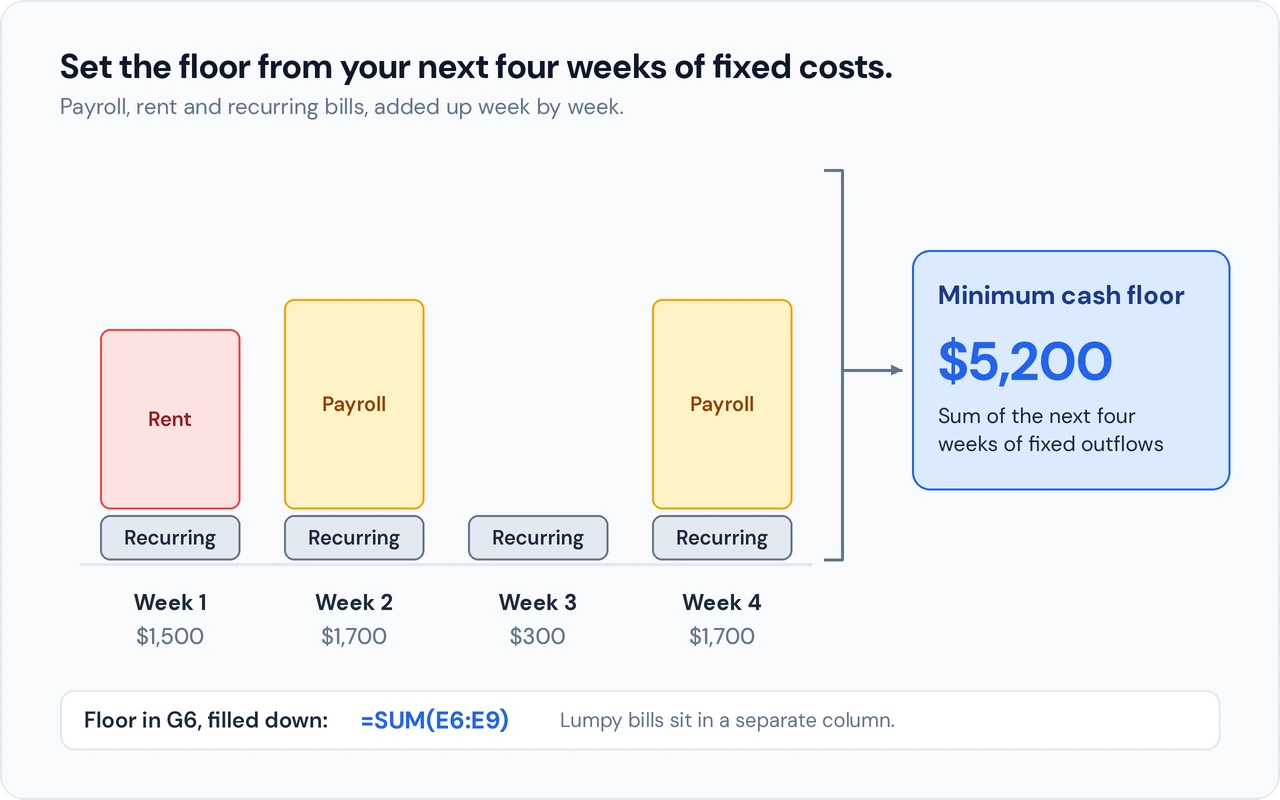
In the example business, two payrolls of $1,400, one $1,200 rent payment and four weeks of $300 recurring bills add up to $5,200. In G6, enter =SUM(E6:E9) and fill it down, then flag each week with =IF(F6<G6,"LOW","OK") in H6.
For a visual alarm, select A6:H31, open Format, then Conditional formatting, choose Custom formula and enter =$F6<$G6 with a light red fill.
Cash Floor vs Reserve in Small Business Cash Flow Management
| Measure | Its job | How to size it |
|---|---|---|
| Cash floor | A weekly alarm on the sheet | The next four weeks of fixed outflows, which is $5,200 in the example |
| Cash reserve | A savings target in a separate account | Stripe’s guide points to at least 60 to 90 days of operating expenses |
The floor tells you when to act this week. The reserve is the cushion you’ve built over the year, so keep the two separate. Track the reserve account on its own, for example in a net worth tracker, so the weekly sheet only holds the operating balance.
- Monthly payroll makes the four-week sum swing from week to week. Use the largest sum as a flat floor with
=MAX(G6:G18). - Seasonal businesses see the floor rise and fall as you add or drop seasonal payroll, because the formula rolls forward with your fixed costs.
- Owner pay belongs in fixed outflows when you take it on a schedule, and in lumpy bills when you take irregular draws.
Cash Flow Management for Small Business Mistake 5: Checking the Balance Once a Month
A month-end balance reads the account after the rent, the invoice and the card bill have all landed. It hides every dip between the 1st and the 30th, and cash flow management for small business works in weeks. Weekly rows expose the cash flow problems that month-end rows bury.
In my cash flow forecasting simulation, 51.4% of 20,000 random six-month schedules had at least one week below a $2,000 buffer. In 40.6% of those, every month-end balance stayed above the buffer, so a month-end check showed nothing. That guide’s late-invoice rule then lifted early warnings from 59.4% to 69.0%.
Weekly Check vs Monthly Check for Small Business Cash Flow Management
Run the check on the same day each week, because a fixed day keeps your numbers comparable. Save a copy of the sheet every time, and after four weeks compare the forecast’s lowest week with the real one.
When the lowest week lands more than a week away from the forecast, fix your customer payment dates before touching anything else. When the balance sits within one payroll of the floor, check twice a week, which is my rule and not a standard. If you tend to skip the routine, tick it off in a habit tracker in Google Sheets.
The Weekly Cash Flow Management for Small Business Routine: 3 Steps and 1 Decision
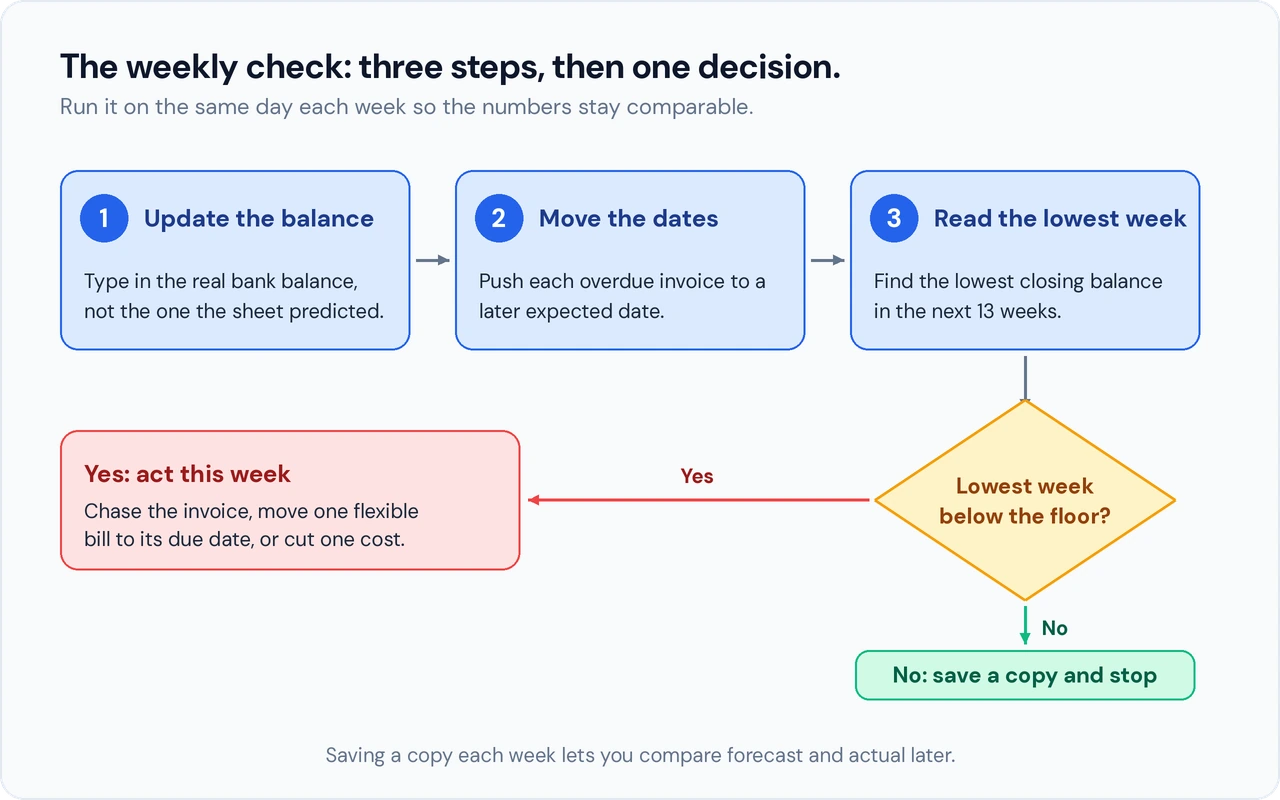
The cash flow management for small business routine runs the five fixes in the same order every week. Three steps feed one decision.
Update the balance
Type the real bank balance into the opening cell for week 1 each time you open the sheet. Leave out reserves and tax set-asides, since money you won’t touch this quarter makes the sheet look safer than it is.
Move the dates
Set any overdue invoice to $0 until the customer gives a payment date, then add it back on that date. That keeps one late payer from propping up the forecast.
Read the lowest week
Use =MIN(F6:F18) for the lowest closing balance in the next 13 weeks. Use =INDEX(A6:A18,MATCH(MIN(F6:F18),F6:F18,0)) for the week it happens, and compare it with the floor in G.
If the lowest week sits under the floor, pick one action this week. Chase the invoice that feeds that week, pay one flexible vendor bill on its due date instead of its arrival date, or cut one recurring cost. If the lowest week sits above the floor, save a copy and stop.
Cash Flow Management for Small Business: Spreadsheet or Software
A spreadsheet fits when you can type in the receipts and bills yourself. Software fits when bank feeds do the typing. Cash flow management for small businesses with a handful of clients usually fits a spreadsheet.
| Criterion | Spreadsheet | Software |
|---|---|---|
| Data entry | You type receipts and bills, so you see every line | Bank feeds can import transactions automatically |
| Forecast logic | Every formula is visible and editable | The vendor builds the logic in, and you adjust settings |
| Cost | A free template or a one-time purchase | Usually a monthly or annual subscription |
| Fits best | A few clients, irregular invoices, one person entering data | Many transactions, several users, payroll or accounting integrations |
I sell a spreadsheet tracker, so I’m biased. For cash flow management for small business, a business with bank feeds, payroll integrations and several people entering data is better off in software, and the cash flow forecasting software guide compares the options. The Google Sheets budget tracker vs budgeting apps post covers the same split for personal budgets.
The tracker below suits freelancers, consultants and small studios that invoice several clients. It has no bank feed, so you type the numbers in yourself, and it has no inventory tab.
Run Cash Flow Management for Small Business From a Ready-Made Tracker
Cash Flow Forecast Tracker Pro rolls a 13-week forecast forward, tags every expected payment as Confirmed, Likely or Possible, and flags weeks that run Low or Negative. You pay once and enter the numbers yourself.
Get Cash Flow Forecast Tracker Pro →
| Feature | Free | Pro |
|---|---|---|
| Manual weekly cash ledger | ✅ | ✅ |
| Current balance and monthly totals | ✅ | ✅ |
| Balance trend chart | ✅ | ✅ |
| Automated rolling 13-week forecast | ❌ | ✅ |
| Confidence-weighted invoicing | ❌ | ✅ |
| Sinking Funds | ❌ | ✅ |
| Runway warnings | ❌ | ✅ |
Start With the Free Tracker for Cash Flow Management for Small Business
The free tracker logs what already happened each week and charts the balance trend, which is the history that Mistakes 2 and 5 need. It tracks the past, and the automated forecast lives in Pro.
People Also Ask About Cash Flow Management for Small Business
How Do Small Businesses Manage Cash Flow?
Cash flow management for small business runs as a weekly loop, where you update the real balance, move overdue receipts to new dates and compare the lowest week in the next 13 with your cash floor. When the lowest week sits under the floor, chase the invoice behind it, pay one flexible vendor bill on its due date or cut one recurring cost. Save a copy each week so you can check the forecast later.
How Much Cash Flow Should a Small Business Have?
Cash flow management for small business needs the lowest weekly balance to stay above a minimum cash floor, and four weeks of fixed outflows is my starting point. For the example business in this guide, that floor is $5,200, which comes from two payrolls, one rent payment and four weeks of recurring bills. Stripe’s guide points to a separate reserve of at least 60 to 90 days of operating expenses.
Why Do Small Businesses Struggle With Cash Flow?
Cash flow management for small business gets hard because costs leave on fixed dates while customers pay on their own schedule. Stripe’s guide lists late customer payments, high overhead, thin reserves, poor forecasting, seasonal swings, inventory bottlenecks and fast growth as the biggest culprits. Mistake 2 covers late customer payments, and Mistake 4 covers thin cushions.
Alex builds free and Pro Google Sheets and Notion templates for budgeting, habits and freelancing. This guide is educational and isn’t financial advice.