
Debt Avalanche Method: Pay Less Interest, 5 Easy Steps
The debt avalanche method sends every spare dollar to your highest-APR debt first. Here are 5 easy steps, a 4-debt example with month-by-month numbers, and the rate-gap test that shows when it pays off.

⏱ 17 min read
What’s in this post:
- A 4-debt example with month-by-month payments for both methods
- A rate-gap test showing what 0 to 12 points of APR spread saves
- Five easy steps with the exact values to enter
- Edge cases for 0% balances, ties, quick wins, and the minimum trap
- A 20,000-set check of avalanche vs snowball on random debts
The debt avalanche method pays the minimum on every debt and sends all extra money to the one with the highest APR. When that balance hits zero, its payment rolls into the next-highest rate, and the money aimed at interest grows with each win.
I tested it on a 4-debt, $16,000 example instead of the usual three-card story. The debt avalanche method saved $782.08 over snowball and finished a month sooner, but the first debt did not clear until month 17. This guide covers the steps, the numbers, and the rate gap that decides whether the debt avalanche method is worth the wait.
Table of Contents
What Is the Debt Avalanche Method?
The debt avalanche method is a debt payoff strategy that pays every minimum and sends all extra money to the debt with the highest APR. When that debt clears, its full payment rolls to the next-highest rate. Under a fixed monthly budget, it pays the least interest of the two best-known debt payoff methods.
Searches for what is the avalanche method lead to the same answer, because the avalanche method is the debt avalanche method with one word dropped. The name fits the mechanics. Each cleared balance adds its payment to the next target, so the amount aimed at your most expensive debt keeps growing.
Interest is the price tag on every dollar you owe, quoted as an APR. The Federal Reserve’s G.19 consumer credit release put the preliminary August 2026 average card rate for accounts assessed interest at 22.36%. At that rate $1,000 costs about $18.63 a month, while the same $1,000 at 12.99% costs about $10.83.
So a dollar that removes principal from the expensive balance stops more future interest than a dollar aimed at the cheap one. The debt avalanche method decides where each dollar lands, and your monthly budget decides how fast you finish. The example below separates those two effects.
| Part | Rule |
|---|---|
| Ranking | Highest APR first, with the smaller balance breaking a tie |
| Minimums | Paid on every debt, every month |
| Extra money | All of it goes to rank 1 |
| When a debt clears | Its full payment rolls to the next rank |
| Slowest part | The first win can take more than a year |
How the Debt Avalanche Method Works in 5 Easy Steps
List every debt with three numbers
Write the balance, APR, and minimum payment for every debt except the mortgage. For avalanche method credit card debt, pull each card statement first, since the APR sits in the interest charge section. Loan APRs show on the servicer dashboard.
If a card lists one APR for purchases and another for cash advances, use the rate on the balance you carry. Add the statement date too, because last month’s balance is already stale.
Fix your monthly debt budget
Add all the minimums, then add the extra you can pay every month without borrowing again. In the example below that is $455 in minimums plus $300 extra, so the budget is $755.
Keep the total at $755 after minimums shrink, because that fixed total is what makes the debt avalanche method work. To find the extra, sort last month by category in a free budget tracker for Google Sheets or an expense tracker in Google Sheets and pick one line you can name.
Rank debts by APR
Sort from the highest APR to the lowest. That list answers which debt to pay off first, and it also settles which credit card to pay off first. Break a tie with the smaller balance, since it clears sooner and frees its payment sooner.
Rank a 0% promo balance at 0% until the month before the promo ends, then re-rank it at the rate it jumps to. The exceptions section shows what that costs and saves.
Pay every minimum, then target rank 1
Set autopay to the statement minimum on every account, then make one manual payment each month to rank 1. That payment equals your budget minus the other minimums.
If a payment clears rank 1 mid-month, send the leftover to rank 2 the same day. A leftover that sits in checking does nothing while rank 2 keeps charging interest.
Roll the freed payment forward and re-rank
When rank 1 reaches zero, its minimum plus the extra becomes the target payment for rank 2. In the example, Card A’s $465 moved to Card B in month 17.
Re-check every APR each quarter. A variable-rate card can change its rate when the prime rate moves, and that can reorder your list.
Write the month you expect each balance to clear next to your debt list. When a real payoff date slips by two months, a rate changed or a new charge landed, and your debt avalanche method plan needs a refresh.
Debt Avalanche Method Example: 4 Debts, Month by Month
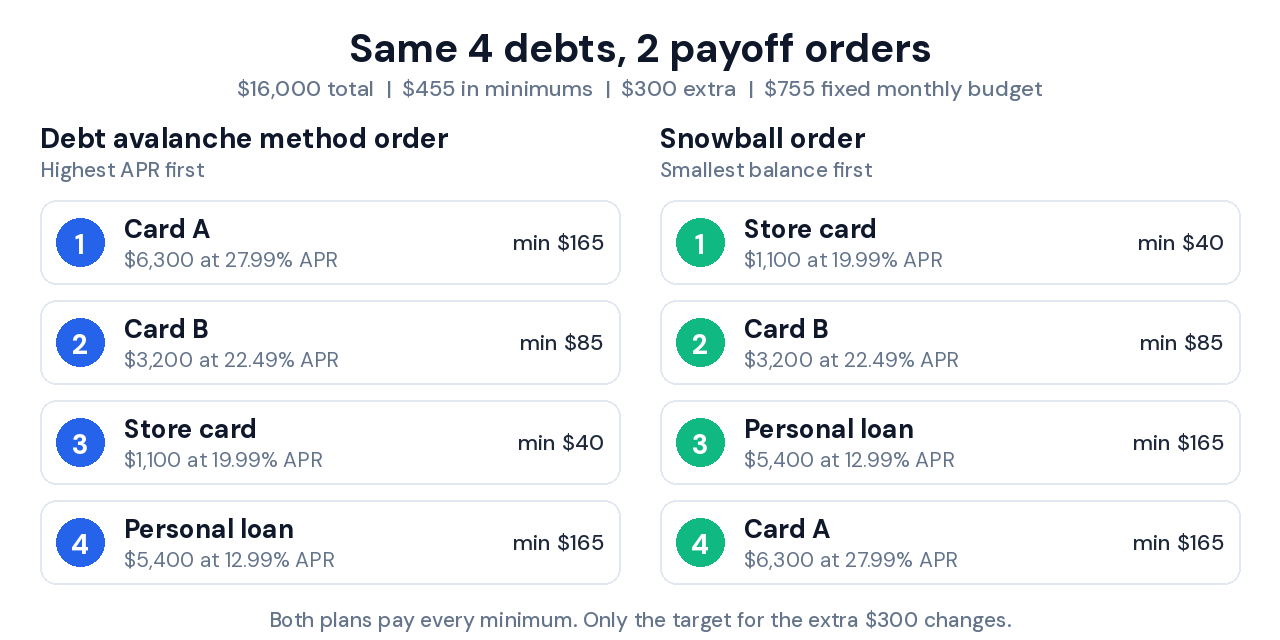
I built this example to push the two methods apart. The biggest balance carries the highest rate, and the smallest balance carries the second-lowest.
| Debt | Balance | APR | Minimum | Avalanche rank | Snowball rank |
|---|---|---|---|---|---|
| Store card | $1,100 | 19.99% | $40 | 3 | 1 |
| Card A | $6,300 | 27.99% | $165 | 1 | 4 |
| Card B | $3,200 | 22.49% | $85 | 2 | 2 |
| Personal loan | $5,400 | 12.99% | $165 | 4 | 3 |
Interest bills first. In month 1 the four debts add $283.70 of interest, and Card A alone adds $146.95 of it. With $455 in minimums and $300 extra, the budget is $755 every month.
In month 1 the debt avalanche method sends $465 to Card A, which is its $165 minimum plus the full $300 extra. Every other debt gets its minimum and nothing more.
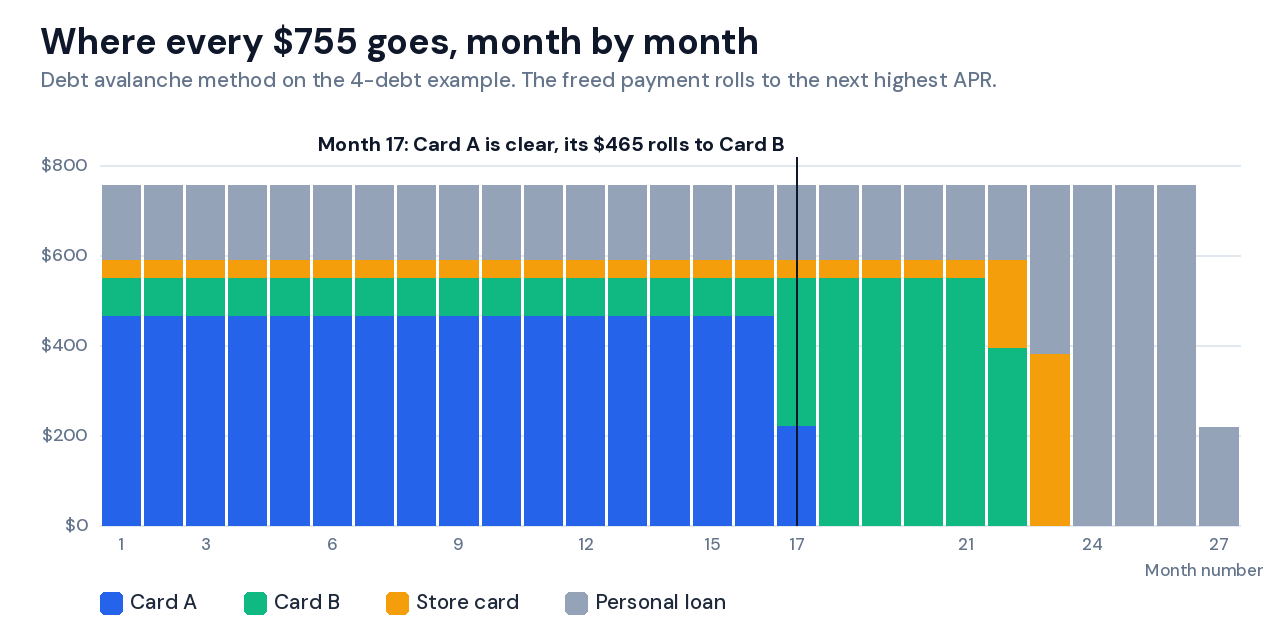
Card A clears in month 17 with a final payment of $221.30, so the other $328.70 of that $755 month goes to Card B. From month 18 Card B receives $550, which is its $85 minimum plus Card A’s $465.
Card B clears in month 22. Month 23 splits $380.95 to the store card and $374.05 to the personal loan, and the store card ends there. The loan, which has the lowest rate, takes the last four months and ends with a $217.58 payment in month 27.
Total debt falls from $16,000 to $9,678 by month 12 and to $3,144 by month 22.
| End of | Store card | Card A | Card B | Personal loan | Total |
|---|---|---|---|---|---|
| Month 1 | $1,078.32 | $5,981.95 | $3,174.97 | $5,293.46 | $15,528.70 |
| Month 6 | $964.40 | $4,276.89 | $3,042.62 | $4,743.19 | $13,027.10 |
| Month 12 | $814.68 | $1,953.61 | $2,866.70 | $4,042.53 | $9,677.52 |
| Month 17 | $678.06 | $0.00 | $2,460.67 | $3,423.06 | $6,561.79 |
| Month 22 | $374.71 | $0.00 | $0.00 | $2,769.32 | $3,144.03 |
| Month 27 | $0.00 | $0.00 | $0.00 | $0.00 | $0.00 |
| Plan | Debt-free month | Total interest | First debt cleared |
|---|---|---|---|
| Avalanche | 27 | $3,847.58 | Month 17 (Card A) |
| Snowball | 28 | $4,629.66 | Month 4 (store card) |
| Minimums only, with rollover | 59 | $10,585.79 | Month 38 (store card) |
| Minimums only, no rollover | 96 | $13,617.83 | Month 38 (store card) |
The gap between the two methods is $782.08 and one month. Rolling payments forward with no extra money is worth $3,032.04 against minimum-only, and the $300 extra adds another $6,738.21. Set up the roll-forward step before you debate avalanche vs snowball.
The size of the extra matters more than most tweaks. Moving it from $200 to $400 cut the plan from 32 months to 23 and the interest from $4,810.28 to $3,225.84.
| Extra per month | Debt-free month | Total interest |
|---|---|---|
| $0 | 59 | $10,585.79 |
| $200 | 32 | $4,810.28 |
| $300 | 27 | $3,847.58 |
| $400 | 23 | $3,225.84 |
I ran every debt avalanche method example in Python. Interest equals balance times APR divided by 12, rounded to the cent and added before each payment, with fixed-dollar minimums and no new charges. Card issuers charge on a daily balance, so your statements will differ by a few dollars.
To run your own balances through both orders, copy the free debt payoff calculator for Google Sheets and compare the Snowball and Avalanche tabs.
Avalanche vs Snowball: How the Debt Avalanche Method Compares
Avalanche vs snowball comes down to one trade. The debt avalanche method buys lower interest with a slower first win, and snowball buys an early win with higher interest.
| Criterion | Avalanche | Snowball |
|---|---|---|
| Orders debts by | Highest APR | Smallest balance |
| Interest in the example | $3,847.58 | $4,629.66 |
| Debt-free month | 27 | 28 |
| First debt cleared | Month 17 | Month 4 |
| Real downside | A long wait for the first win | Pays more when rates differ, and the gap grows with the spread |
| Fits you when | Rates sit 6 or more points apart | Rates sit within 3 points and small balances keep you paying |
The rate gap changes the trade. I kept three debts of $3,000, $6,000, and $9,000 with a $750 monthly budget, put the highest rate on the biggest balance, and widened the gap between the highest and lowest APR from 0 to 12 points.
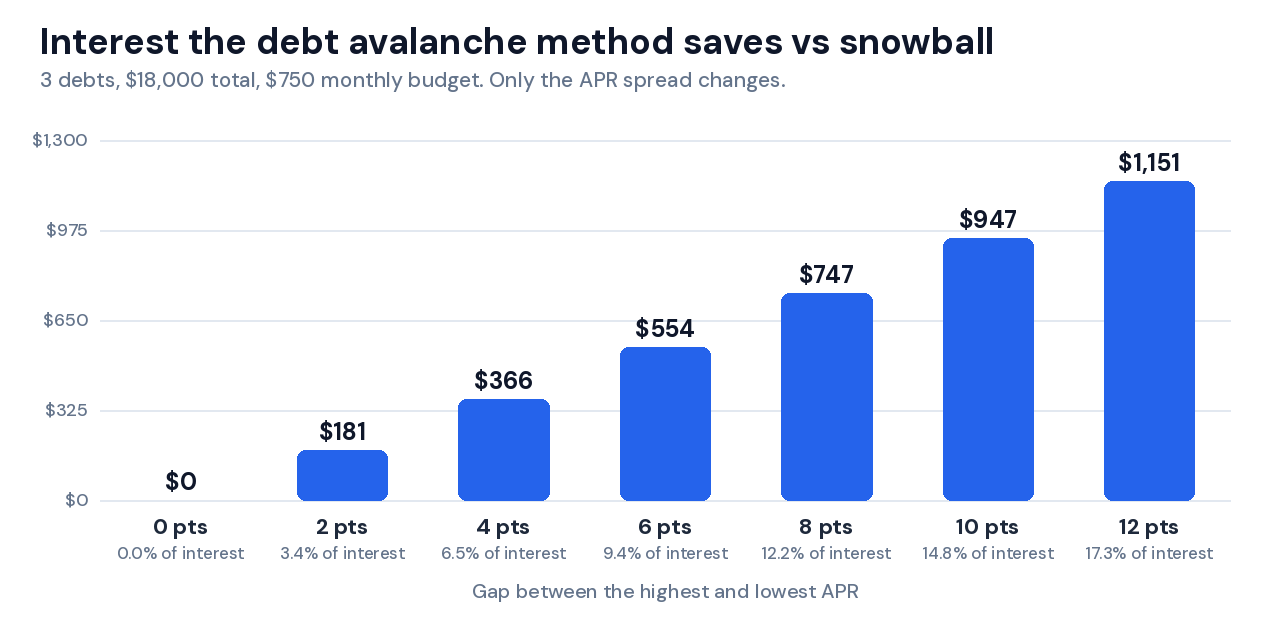
| APR spread | Avalanche interest | Snowball interest | Saved | Months (avalanche / snowball) |
|---|---|---|---|---|
| 0 points | $5,178.76 | $5,178.76 | $0.00 | 31 / 31 |
| 2 points | $5,220.42 | $5,401.58 | $181.16 | 31 / 32 |
| 4 points | $5,267.23 | $5,633.47 | $366.24 | 32 / 32 |
| 6 points | $5,319.37 | $5,873.39 | $554.02 | 32 / 32 |
| 8 points | $5,376.65 | $6,124.02 | $747.37 | 32 / 33 |
| 10 points | $5,438.87 | $6,386.16 | $947.29 | 32 / 33 |
| 12 points | $5,506.59 | $6,657.51 | $1,150.92 | 32 / 33 |
Each extra point of spread added about $90 to $100 of savings. At a 2-point gap avalanche saved $181.16 over 31 months, about $6 a month, and at 0 points it saved nothing because both plans finish identically.
That setup is the worst case for snowball, since the largest balance carries the highest rate. Treat the savings as ceilings.
To see how often the ceiling applies, I ran 20,000 random debt sets with 2 to 6 debts, balances from $300 to $15,000, APRs from 0% to 29.99%, and extra payments from $50 to $600. The debt avalanche method never cost more than snowball and never finished later. The median saving was $909.61, but 21.6% of sets saved under $100, and 16.2% matched to within 5 cents.
My free debt payoff calculator post ran a separate 19,780-set check and reached the same result. Fixed-dollar minimums and a fixed budget drive that result, so percentage-based minimums and fees can move it.
I would use the debt avalanche method at a 6-point gap or wider, since that saved $554.02 or more in the test. Under 3 points the saving is small enough that the plan you will keep paying matters more. From 3 to 6 points, avalanche with one quick win is a fair middle.
I am not a financial advisor. These figures are arithmetic on made-up debts, so run your own balances, rates, and fees before you choose between the debt avalanche method and snowball.
What Research Says About the Debt Avalanche Method
Three peer-reviewed studies explain why a method that wins on arithmetic can still lose people. None of them says the math is wrong.
- Amar and colleagues (2011) ran four experiments in the Journal of Marketing Research and saw people pay off small debts first even when larger debts carried higher rates. Restricting full payoff of small debts and focusing attention on accumulated interest helped participants reduce debt faster. Read the abstract.
- Gal and McShane (2012) studied clients of a debt settlement company in the Journal of Marketing Research (Kellogg listing). The NBER working paper that cites their data says people who used a snowball-style approach, paying small debts first, were more likely to eliminate their debt after controlling for debt size, and it calls the evidence suggestive.
- Kettle and colleagues (2016) reported in the Journal of Consumer Research that concentrating repayment in one account raises motivation, with the strongest effect when the target is the smallest account (abstract). A Georgetown release describes one experiment where debts were repaid 15% faster.
I read these studies as a warning about visibility. People quit when progress hides inside one big balance. Amar and colleagues also saw gains from attention to accumulated interest, so an interest-paid-so-far column belongs in your debt avalanche method sheet.
Two habits keep the plan alive. Track percent paid on every debt, not only the target, and log interest paid so far. If the first win sits more than a year away, take the quick win from the next section.
When the Debt Avalanche Method Needs an Exception
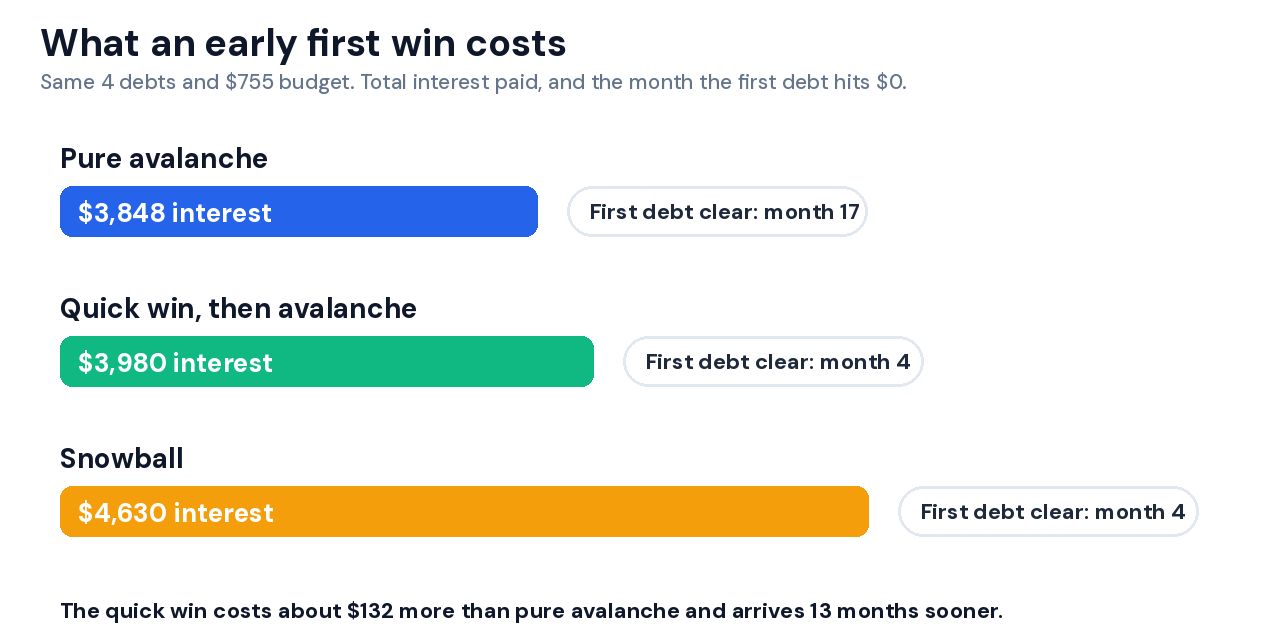
Take one quick win when the first payoff is far away. Clearing the $1,100 store card first takes 4 months. Then avalanche takes over, and the plan still finishes in month 27 with $3,979.60 of interest.
That is $132.02 more than pure avalanche and $650.06 less than snowball, and the first debt clears 13 months sooner. The price rises with the size of the detour, since clearing Card B first costs $251.08 more than pure avalanche and delivers its win in month 10.
Rank 0% balances last. I tested a $2,500 medical plan at 0%, a $3,500 card at 24.99%, and a $4,000 loan at 9.99% with $250 extra. The debt avalanche method finished in 21 months with $882.39 of interest, while paying the 0% plan first took 22 months and $1,443.84, which is $561.45 more.
Treat a promo balance as 0% until it nears expiry. A $3,000 promo card sits at 0% for 8 more months and then jumps to 26.99%, next to a $3,500 card at 24.99% and a $4,000 loan at 9.99%. Ranking the promo balance at 26.99% from day one cost $1,550.21 in interest, while waiting until month 8 to re-rank cost $1,374.55, a $175.66 difference.
That test assumes a true 0% rate that charges 26.99% only on the balance left after the promo. A deferred-interest store promo can bill back interest from the purchase date, so read the terms before you copy the plan. If the full $3,000 survives to expiry, the first month at 26.99% costs $67.48.
Break ties by balance. Three cards at 22.99% ($2,000, $7,000, and $4,000) with $250 extra finished in month 29 with $4,050.70 of interest under both orders, identical to the cent. Pick the smaller balance first, because it frees a payment sooner and the total does not change.
Hold your payment steady as minimums fall. A $6,000 balance at 24.99% costs $124.95 in interest the first month, so a flat $125 payment removes 5 cents of principal. At that pace the debt takes 380 months and about $41,500 in interest, while a flat $150 takes 87 months and $7,025.42.
Plan for uneven months. In the example, skipping the $300 extra for months 7 to 9 added $417.95 of interest and pushed the finish to month 29, while a $1,000 lump sum in month 6 saved $460.84 and ended the plan in month 25. Freelancers can set the fixed budget at the minimums plus the smallest extra they can pay in a slow month, then send surplus lumps to rank 1.
Forecast the slow months with a cash flow forecast template, log what clients owe in a freelance invoice tracker, and keep business costs apart in a freelance expense tracker. If you want to compare tools first, read how to choose cash flow forecasting software.
Check the rules before you rank student loans. The ranking math is identical, but federal loans carry repayment options such as income-driven plans and forgiveness programs that an APR list ignores. Review your options at StudentAid.gov or with your servicer before sending extra money to a federal loan.
Track the Debt Avalanche Method in a Spreadsheet
A spreadsheet suits the avalanche method to pay off debt because every formula stays visible. Log one row per debt each month with the starting balance, APR, minimum, interest charged, payment, and ending balance.
Use this formula for monthly interest, with the balance in B2 and the APR as a decimal in C2. =ROUND(B2*C2/12,2) returns the charge to the cent. A bigger gap against your statement usually means a wrong APR or a new charge.
Rank debts with =COUNTIF($C$2:$C$5,">"&C2)+COUNTIFS($C$2:$C$5,C2,$B$2:$B$5,"<"&B2)+1. It counts higher APRs first and smaller balances among ties, so the result is 1 for the debt that gets the extra money.
- Interest charged against the ROUND formula above
- APR on the statement against your sheet, since promos end and variable rates move
- New charges on any card in the plan, because each one adds to a balance you are shrinking
- Rank order after any change in a balance or a rate
- Expected clear month against the date you wrote down
The free debt payoff calculator for Google Sheets already runs both orders, and the free budget tracker for Google Sheets finds the monthly extra. Add your debts to a net worth tracker in Google Sheets to watch the total fall, or use the personal finance Google Sheets template if you want budget, debts, and net worth in one file.
If you live in Notion, a Notion budget tracker template covers the monthly extra, and the Notion Life OS template can hold your debt-free date as a goal. Put payment day on a habit tracker in Google Sheets or a Notion habit tracker template, since the plan works only when the target payment leaves your account every month.
Prefer an app? FinCompareLab reviews the best budgeting apps for debt payoff, and my Google Sheets budget tracker vs apps comparison covers the trade-offs.
Free Debt Payoff Calculator for Google Sheets
Enter your balances, APRs, and minimums once and compare the debt avalanche method with snowball on your own numbers.
Get the Free Debt Payoff Calculator →
Debt Avalanche Method Questions People Ask
Which Is Better, the Debt Avalanche Method or the Snowball Method?
The debt avalanche method pays less interest under a fixed budget and never cost more than snowball in 20,000 random tests, while snowball clears the first debt sooner. In the 4-debt example the gap was $782.08 and one month, and the first win arrived 13 months later.
- Pick avalanche when the highest and lowest APR sit 6 or more points apart.
- Pick snowball when rates sit within 3 points and small balances keep you motivated.
- Pick the quick-win version when the top-rate debt takes more than a year to clear.
Is the Debt Avalanche Method the Best Debt Elimination Method?
The debt avalanche method is the cheapest of the common debt payoff methods under a fixed budget, but the best debt payoff method is the one you keep paying. Some sites call the same highest-APR-first ordering debt stacking, and the other debt payoff methods trade a little interest for earlier wins.
| Method | Orders by | Strength | Weak spot |
|---|---|---|---|
| Avalanche | Highest APR | Lowest interest | Slow first win |
| Snowball | Smallest balance | Early wins | More interest when rates differ |
| Quick win, then avalanche | One small debt, then APR | Early win with most of the savings | Cost $132.02 in the example |
| Consolidation or balance transfer | Replaces several debts with one | One payment | Fees and promo rates that end |
How Long Will the Debt Avalanche Method Take on $20,000 of Credit Card Debt?
At the 22.36% average card rate, $20,000 takes 34 months at $800 a month and 53 months at $600. At $400 a month it takes 146 months, because the first month’s interest alone is $372.67.
| Monthly payment | Months to pay off | Total interest |
|---|---|---|
| $400 | 146 | $38,139.11 |
| $600 | 53 | $11,542.43 |
| $800 | 34 | $7,171.79 |
| $1,000 | 26 | $5,258.02 |
| $1,500 | 16 | $3,208.88 |
That table assumes one balance and no new charges. For avalanche method credit card debt across several cards, APR sets the order and the monthly total sets the timeline.
Debt Avalanche Method FAQ
How does the debt avalanche method work?
The debt avalanche method ranks your debts from highest to lowest APR, pays every minimum, and sends all extra money to rank 1. When rank 1 reaches zero, its full payment moves to rank 2. You repeat that until every balance is zero.
Does the debt avalanche method work for credit card debt?
Yes, the debt avalanche method fits credit cards well because card APRs often differ by several points. For avalanche method credit card debt, confirm each card’s current rate first, since variable APRs and expired promos can reorder the list.
Does the debt avalanche method hurt your credit score?
The debt avalanche method does not change your credit score by itself. Paying every minimum on time and lowering card balances are the habits that tend to help, and a missed minimum is the one move that clearly hurts.
Can the debt avalanche method include 0% balances?
Yes, the debt avalanche method ranks a 0% balance last, because paying it early saves no interest. In my 3-debt test that order saved $561.45 over paying the 0% plan first. Re-rank the balance once a promo is within a month of expiring.
What if two debts tie in the debt avalanche method?
Pay the smaller balance first when two debts tie in the debt avalanche method, since it clears sooner and frees its payment sooner. In my tie test, three cards at 22.99% finished in the same month with identical interest under both orders.
How often should I re-rank in the debt avalanche method?
Re-rank the debt avalanche method list every quarter, and again whenever a card changes its APR or a promo ends. Variable-rate cards can move when the prime rate moves. Update the rank column in your sheet and keep the same total budget.
What happens to a paid-off minimum in the debt avalanche method?
In the debt avalanche method, a paid-off debt’s minimum joins the target payment for the next debt. Rolling alone cut the 4-debt example from 96 months to 59 months and from $13,617.83 to $10,585.79 of interest, before any extra money.
Is the debt avalanche method worth it if interest rates are close?
The debt avalanche method saved $181.16 at a 2-point gap in my test, about $6 a month, and nothing at 0 points. Under about 3 points, choose the plan you will keep paying. At 6 points the saving passed $554.
Can I combine the debt avalanche method with a balance transfer?
Yes, you can run the debt avalanche method on the debts left after a transfer, as long as you count the fee. A 3% fee on $5,000 is $150, and at 24.99% that balance costs $104.13 in monthly interest, so the fee equals about 1.4 months of interest. Confirm the promo length and the rate after it ends first.
Is there a free debt avalanche method calculator?
Yes, this free debt avalanche method calculator in Google Sheets runs avalanche and snowball side by side from your balances, APRs, and minimums. Copy it, enter each debt once, and compare the two payoff dates.
About Alex. Alex builds free and Pro Google Sheets and Notion templates at Tools Without Code. The numbers in this guide come from Python simulations on made-up debts, so check them against your own statements and treat them as arithmetic, not advice.